
What would stop you from trying Micro Calendar (https://microcalendar.com.au/) this month? Be specific about how you handle this today. Also say the maximum you would pay per month in USD (0 if nothing).
Page reviewed
MicroCal - Unified calendars, smart booking, and paid meetings | MicroCal
https://microcalendar.com.au/ (opens in a new tab)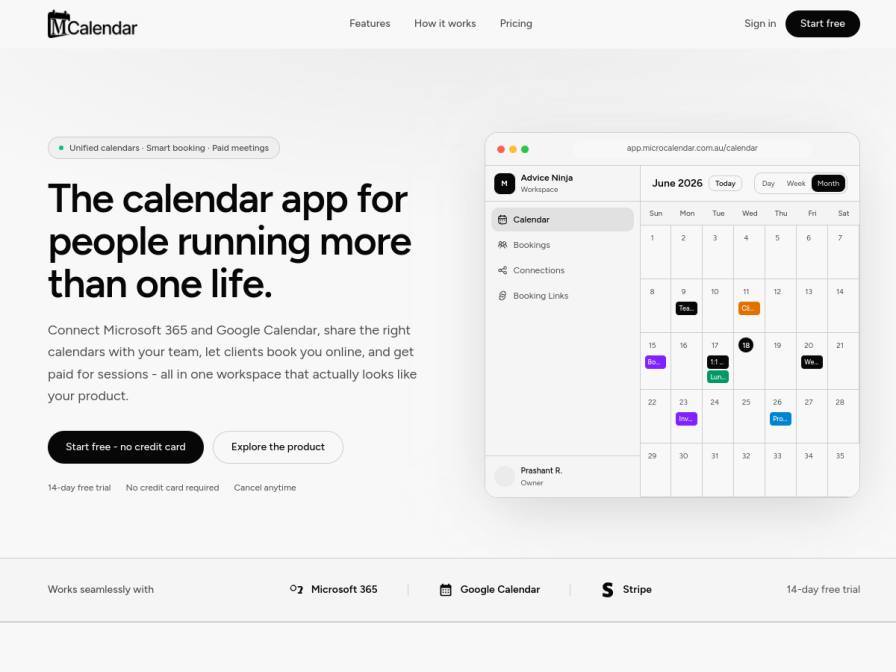
10 fictional AI personas. Exploratory perspectives, not a survey of real customers. Methodology & limitations
Simulated interest
AI synthesis, not measured demand
Suggested price range
Median $15 · simulated willingness to pay
Response sentiment
What this panel suggests
Responses were mostly neutral: people can see the appeal of unifying Microsoft 365 and Google Calendar, but the main reasons they would not try MicroCal this month are migration risk and trust. Several respondents already handle this today by manually checking multiple calendars, using a master spreadsheet, or relying on fragmented tools that are clunky but familiar. That makes switching feel like a meaningful operational change, so they want strong reassurance that existing appointments and client data will sync cleanly with no loss. Pricing is a secondary but real hurdle. With a median willingness to pay of $15/month, the $20 Starter plan feels harder to justify unless the product clearly saves time or reduces scheduling mistakes right away. The page’s promises around real-time sync and no-IT setup may help, but the reactions suggest a clarity and proof problem more than a lack of interest in the concept.
Pricing & positioning
Trial-first positioning looks safest; if you charge immediately, the entry point needs to feel clearly below or equal to the median willingness to pay.
The supplied responses put median willingness to pay at $15/month versus a $20/month Starter plan. The main pricing barrier is not absolute rejection, but whether the product proves enough time savings and risk reduction to justify switching from current workarounds.
Recurring themes
“The biggest hurdle would be integrating it seamlessly with my existing Microsoft 365 and Google calendars without creating more complexity.”Read Mandy Simonis’s response →
“Right now, I manually check both, and sometimes even a third for my teaching gig, which is already a mental drain.”Read Mandy Simonis’s response →
“The idea of paying for another tool, especially with my income, makes me hesitate.”Read Eva Morel’s response →
Objections to investigate
- Fear of integration friction or data loss during migration
- Satisfaction with current manual spreadsheets or fragmented tools
- Uncertainty about ROI relative to the entry price
Use these findings to plan customer interviews or experiments. How to interpret AI research
What the panel said
Click a name to open that persona’s full profile.
Mandy SimonisneutralThe biggest hurdle would be integrating it seamlessly with my existing Microsoft 365 and Google calendars without creating more complexity. Right now, I manually check both, and sometimes even a third for my teaching gig, which is already a mental drain. I'd need to be convinced it truly unifies them without any hiccups or data loss. The idea of a unified view is appealing, though. I'd be willing to pay up to $20 per month.
Simulated interest: 60/100
Jeremiah KossneutralThe main thing stopping me is the thought of migrating everything. I currently manage my work calendar in Microsoft 365 and my personal one with Google Calendar. To avoid clashes, I religiously use a master spreadsheet to cross-reference availability, which is a bit of a faff but it works. I'd need to be absolutely sure that all my existing client data and appointments would transfer over seamlessly without any risk of loss. The idea of having to retrain my clients on a new booking system is also a concern, as most still prefer email. I'd be willing to pay up to $15 per month.
Simulated interest: 50/100
Ella HingsenneutralThe biggest hurdle for me right now is integrating my existing systems. I'm already using Calendly, Google Calendar, and Microsoft 365, and my biggest fear is creating more fragmentation, not less. While Micro Calendar seems promising in unifying calendars, I'd need to see how seamlessly it syncs with my current Calendly setup and how much manual work would be involved in transitioning. I'm also a bit wary of adding another subscription, given I just invested in a CRM. If it truly solves the calendar headache and integrates well, I'd be willing to pay up to $25 per month.
Simulated interest: 60/100
Chidaatma PatelneutralRight now, the biggest hurdle is managing the overlap between my Google Calendar for freelance projects and my Outlook calendar for that one enterprise contract. I currently use a spreadsheet to track the paid 1:1 reviews I do in the evenings to avoid double-booking, which is a bit clunky. While integrating both calendars sounds beneficial, I'm not sure if it perfectly solves the specific problem of cross-time-zone scheduling for my paid sessions without creating new complexities. For a tool that promises to unify calendars and handle bookings, I'd be willing to pay up to $15 per month.
Simulated interest: 60/100
Eva MorelneutralHonestly, the biggest thing stopping me is that I manage my teaching schedule through a mix of emails, WhatsApp, and my personal Google Calendar. It's free, and while it takes time, I'm used to it. The idea of paying for another tool, especially with my income, makes me hesitate. I'd need to see a really significant time-saving benefit to justify a monthly cost. I'm not sure about the pricing structure either, if it's per user or per workspace, as I'm the only one managing my schedule. If it could truly automate away the back-and-forth for bookings and confirmations, maybe up to $10 USD per month would be a consideration.
Simulated interest: 30/100
Darrel CummingsneutralRight now, I'm not super worried about unifying my calendars since I mostly use my Google Calendar and keep my personal stuff separate. The biggest thing holding me back is the admin overhead of payments. I currently use a free scheduling link and handle payments separately, which works fine for now. If Micro Calendar could simplify that whole process, especially with Stripe integration, I'd be more interested. I'm aiming to increase my income, so if this tool demonstrably helps me get more clients or streamline payments, I'd consider it. My max would be $20 per month.
Simulated interest: 40/100
Myra BraunneutralMy primary concern is the manual control I have over my client interactions. While the idea of unifying my Outlook and Google calendars is appealing, I'm wary of any system that might automate too much of the booking process. I currently manage all my appointments myself via email and phone, and I keep a paper diary as a backup. This gives me a sense of security that a fully automated system might disrupt. I'd need to be convinced that this tool wouldn't introduce complexity or data privacy issues, given my past experiences with scheduling software. I would be willing to pay up to $15 per month.
Simulated interest: 30/100
Manoah van der VeldeneutralThe main hurdle for me would be integrating this with my existing Microsoft 365 Bookings for internal client meetings. I've streamlined that process, and while I use a competitor for paid training calls, I don't want to create another separate system if this can't fully replace both. It’s the administrative overhead of managing multiple tools that I want to avoid. I'd need to see if it can handle both internal meetings and external paid sessions seamlessly before I’d consider it. If it genuinely merges both without adding complexity, I might consider paying up to $20 per month.
Simulated interest: 50/100
Pelagia SienkiewiczneutralMy current system for managing my work and personal calendars is pretty manual, mostly relying on separate digital calendars and my trusty spreadsheets for client availability. The idea of unifying them is appealing, especially since I often switch between my laptop and phone. However, what would stop me from trying Micro Calendar this month is the potential complexity of integrating my existing Microsoft 365 and Google Calendar accounts. I'd need to be sure it wouldn't create more work or sync issues. I'm also a bit hesitant about the $5 platform fee on paid bookings; while I understand the need for revenue, I'd want to see how that impacts my overall earnings. Given my income, I'd be willing to pay up to $15 per month for a tool like this, provided it truly simplifies my workflow without adding overhead.
Simulated interest: 60/100
Amarnath NehrunegativeI'm currently managing my schedule using WhatsApp and Google Calendar, and I manually update my phone's calendar. The biggest hurdle for me is the cost. While the idea of unified calendars and smart booking sounds very useful, especially to avoid the manual copying I do now, I've never paid for a scheduling product. The 'Starter' plan at $20/mo is more than I'd be willing to spend right now, given my budget constraints and focus on saving. I'd need to see a much clearer, immediate benefit to justify any monthly expense.
Simulated interest: 20/100
Keep exploring.
Find your next question or see which topics divide AI panels.
What would you ask next?
Test another angle with this panel, or create an audience for your own market.