
What do you use today instead of Vibld (https://vibld.com) (a competitor, a spreadsheet, doing it by hand)? Compared with that, what would make Vibld better or worse for you, and what would keep you on your current option? Also say the maximum you would pay per month in USD (0 if nothing).
Page reviewed
vibld | AI application builder | Vibe. Build. Ship.
https://vibld.com/ (opens in a new tab)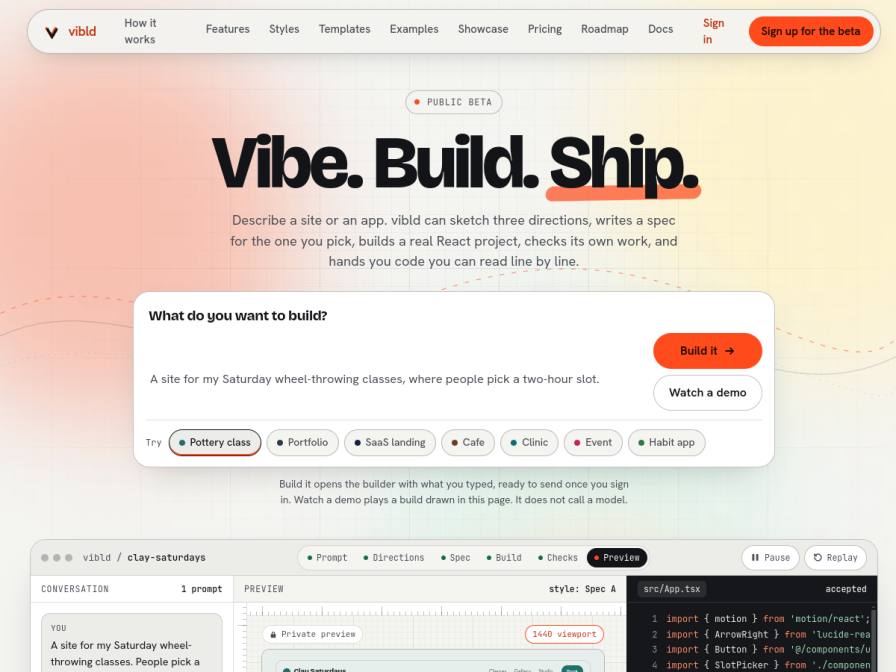
10 fictional AI personas. Exploratory perspectives, not a survey of real customers. Methodology & limitations
Simulated interest
AI synthesis, not measured demand
Suggested price range
Median $19 · simulated willingness to pay
Response sentiment
What this panel suggests
Across the batch, the main alternatives to Vibld are hand-coded React projects, competitor AI builders like v0, and earlier design/prototype workflows such as Figma. The strongest appeal of Vibld is that it promises real, portable code rather than a black box, plus clearer ownership and less lock-in. That matters because several respondents want to avoid rewrites and technical debt. What would make Vibld better for them is confidence that the generated code is maintainable, integrates cleanly with existing component libraries, and can handle more than simple landing pages. What would make it worse is uncertainty about complex state management, data-heavy interfaces, or whether the output is robust enough for production use. The current option is kept mainly because it is already trusted, familiar, and predictable. Pricing did not look like a hard blocker, but the model-spend and per-run structure was confusing and needs clearer explanation. Reported willingness to pay clusters around a modest monthly subscription, with some people at zero and others willing to pay more if the product proves itself.
Pricing & positioning
Keep a free or low-friction entry point, then anchor the main paid plan near the reported median willingness to pay. The clearest pricing opportunity is not lowering price first, but making model spend and per-run costs easier to understand.
Respondents appear receptive to paying when Vibld clearly saves time and returns portable React code they can own.The main blocker is not the subscription itself; it is uncertainty about maintainability, complexity, and what usage actually costs.A $19/month entry point is directionally aligned with the median reported willingness to pay, while a higher tier can make sense for heavier users if the value is obvious.
Recurring themes
“The idea of Vibld generating actual React code is appealing, especially if it means less time spent on boilerplate.”Read Victor Gleichner’s response →
“I would need to understand the quality of the generated CSS and how easily it integrates with our existing component library.”Read Brandon de Ruiter’s response →
“However, the pricing structure is a bit unclear. The 'Build' plan is $19 a month, but the included 'model spend' is $14.00.”Read Wilhelm Kampf’s response →
Objections to investigate
- Uncertainty regarding AI-generated code maintainability and complexity
- Lack of clarity on 'model spend' limits and overage costs
- Inability to handle complex state management or data-intensive interfaces
Use these findings to plan customer interviews or experiments. How to interpret AI research
What the panel said
Click a name to open that persona’s full profile.
Victor GleichnerneutralRight now, we're mostly doing things manually or with basic prototypes in Figma. We're building a web app for customer onboarding and status tracking, so anything that speeds up frontend development without creating lock-in is interesting. The idea of Vibld generating actual React code is appealing, especially if it means less time spent on boilerplate. However, I'd need to see how easily it integrates with our existing React codebase and if the generated code is maintainable. I'm concerned about the "AI" aspect potentially leading to unreadable or overly complex code that we can't easily iterate on, which is critical for us. Given our pre-seed status, I'd be looking at something around $19 a month, maybe $49 a month if it significantly boosts our development velocity and produces clean, standard React code.
Simulated interest: 60/100
Tanya WindlerneutralI currently use v0 to generate React prototypes, which is quick and allows me to iterate rapidly. Vibld's promise of generating clean, portable React code is appealing, especially the emphasis on owning the code and avoiding lock-in. What would make it better is more transparency around the AI's decision-making process – I'm wary of black boxes. If it can truly deliver production-ready code that integrates easily without extensive refactoring, that would be a huge win. The main reason I’d stick with my current method is if Vibld’s output required more manual cleanup than I currently deal with. I'd be willing to pay around $20 per month for a tool like this, assuming the model spend is reasonable.
Simulated interest: 70/100
Wilhelm KampfneutralCurrently, I rely on spreadsheets and manual process mapping to define requirements for my clients. Vibld's promise of generating real React code is appealing, especially the open-source aspect and the fact that it avoids proprietary runtimes. This means I could integrate the output directly into my workflow without vendor lock-in. However, the pricing structure is a bit unclear. The 'Build' plan is $19 a month, but the included 'model spend' is $14.00. If a build requires more than that, what is the cost? I'd need to understand the per-run cost or top-up charges better. For now, I would pay $19 per month for the 'Build' plan if the model spend is sufficient for typical small projects.
Simulated interest: 60/100
Sitara GowdaneutralCurrently, my team and I use AI-first builders for initial front-end prototypes, and then we refine the codebase manually. The idea of Vibld generating a full React project with actual code that we can own and modify is appealing, especially since it emphasizes portability and no lock-in. This could save us considerable time in the initial scaffolding phase. However, I'm concerned about the quality and maintainability of the AI-generated code after the initial pass. Ensuring it integrates seamlessly with our existing backend work and meets our quality standards will be key. I would need to see how well it handles more complex requirements beyond basic UIs before committing. If it truly delivers on generating production-ready code quickly, I might consider paying around $20 per month.
Simulated interest: 60/100
Lorena HarveyneutralRight now, I'm managing everything with spreadsheets and shared documents, plus a part-time contractor for the technical bits. The biggest advantage I see with something like Vibld is the potential to automate the creation of the internal request tracker and customer portal I'm building. It sounds like it could save a lot of manual effort. However, I'm concerned about vendor lock-in and how easily I can integrate this with our existing systems. Since I've never paid for an AI app builder before, I'd need to see a clear, significant improvement over my current method to justify the cost. I would be willing to pay up to $19 per month for a tool like this.
Simulated interest: 50/100
Earl FarrellneutralToday, I'm using tools like v0 to prototype, but I always rewrite the output into our standard React/TypeScript stack. What makes Vibld appealing is its promise of generating conventional, portable React code without proprietary runtimes. That aligns perfectly with my team's need for maintainable code. However, I'd need to see a clear demonstration of how it handles complex state management and integrates with existing patterns before committing. The 'per run' pricing model is also a bit unclear; I'd prefer a clearer understanding of what constitutes a 'run' and its worst-case cost versus actual usage. I'm not willing to pay more than $0 per month at this time.
Simulated interest: 40/100
Angélina LeroypositiveRight now, I'm usually building landing pages and small admin tools by hand or with a combination of no-code tools and custom code. I'm always looking for ways to accelerate development, especially for my side projects. Vibld generating real React code is interesting, and the fact that it's open-source and doesn't lock me in is a huge plus. It seems like it could speed up the initial build phase significantly, letting me focus more on the unique aspects of a project. I'm curious about how well it handles more complex logic or custom integrations, though. If it can reliably generate clean, readable code for backend logic and doesn't require a lot of cleanup, I'd consider it. I'd be willing to pay around $19 per month, assuming it fits well into my workflow and saves me significant time.
Simulated interest: 75/100
Chetan Pilla-SinghneutralRight now, we're essentially doing everything manually or using Google Sheets to track progress. We're building a logistics software, so something that can quickly generate front-end code, especially for internal tools or dashboards, could be useful. Vibld's ability to ship real React code without lock-in is appealing. However, I'm concerned about how well it would handle complex, data-intensive interfaces needed for logistics. It sounds more suited for marketing sites or simpler applications. I would need to see if it can handle custom components and data binding effectively for our use case. If it can, I might consider paying around $19 per month for the 'Build' plan, but only if it significantly speeds up our UI development for non-core features.
Simulated interest: 40/100
Isabel GottliebneutralRight now, for our volunteer sign-up and event dashboard, we're using a combination of spreadsheets and manual processes, with some custom development planned but not yet implemented. Vibld seems interesting because it generates actual React code, which is appealing since we work with contractors for implementation. However, it's unclear if it can handle the complexity of our specific workflows, especially the data management and integrations needed for our nonprofit's CRM and donor database. The pricing model is also a bit vague regarding model spend and usage limits for a nonprofit context. I'd be willing to pay up to $20 per month, provided it can demonstrate clear value and fit within our tight budget.
Simulated interest: 50/100
Brandon de RuiterneutralCurrently, we build frontends manually, iterating on Figma designs and then writing React and TypeScript code. We also use AI tools for boilerplate, but always review the output critically. Vibld's promise of generating readable, portable React code with a clear spec and checks is appealing. The ability to see the spec and the checks is a significant advantage over blindly trusting an AI. However, I would need to understand the quality of the generated CSS and how easily it integrates with our existing component library. The pricing structure, particularly the "Build" tier at $19 a month with $14.00 of model spend, seems reasonable for initial exploration, but I'd need to see how far that model spend goes in practice. For now, I would pay $0 as I need to test its output against our current workflow and assess the potential for technical debt. I'd want to see if the generated code requires significant refactoring.
Simulated interest: 50/100
Keep exploring.
Find your next question or see which topics divide AI panels.
What would you ask next?
Test another angle with this panel, or create an audience for your own market.