
Looking at Topicstotalkabout (https://topicstotalkabout.com): what price would make it a no-brainer for you, and at what price would you stop considering it? What would you expect to get for that money? Also say the maximum you would pay per month in USD (0 if nothing).
Page reviewed
Topic Research & Topical Map Builder | TopicsToTalkAbout
https://topicstotalkabout.com/ (opens in a new tab)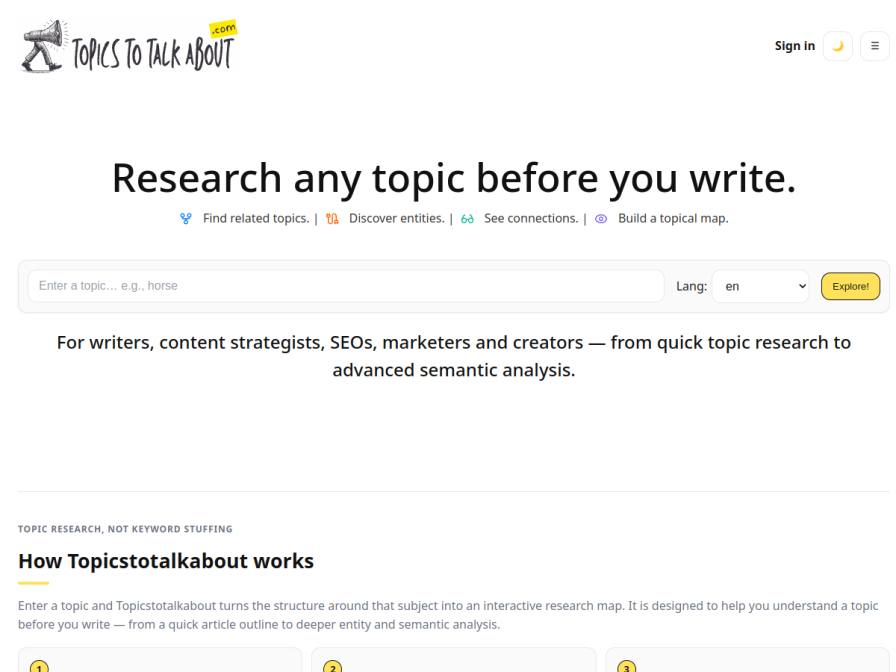
10 fictional AI personas. Exploratory perspectives, not a survey of real customers. Methodology & limitations
Simulated interest
AI synthesis, not measured demand
Suggested price range
Median $50 · simulated willingness to pay
Response sentiment
What this panel suggests
The biggest pricing signal is that the product’s current free status makes it an easy yes for many respondents, so the strongest “no-brainer” price is effectively $0 while the tool remains free. When asked what they would pay, the group still shows meaningful appetite for a paid version: the aggregate willingness-to-pay runs from $15 to $100 per month, with a median of $50. That suggests people see value in semantic topic discovery, but only if the paid tier adds clear practical benefit. The recurring expectations are not for more buzzwords, but for workflow value: unlimited topic generations, richer export formats beyond PDF/PNG, history or saved work, and integrations with tools such as Notion or Semrush. The main friction points are budget sensitivity, uncertainty about return on investment, and overlap with existing research methods. Overall, the audience seems open to paying for a useful research companion, but a monetization plan should stay value-led, preserve a free entry point, and reserve paid plans for heavier or more frequent users.
Pricing & positioning
Keep a generous free tier or free trial, since the current free offering is the main reason people treat it as a no-brainer. If monetized, position a paid plan for frequent researchers, SEOs, writers, and agencies who need recurring topical mapping.
The aggregate willingness-to-pay spans $15 to $100 per month, with a median of $50. That suggests room for a low-friction starter plan around $15-$30 and a stronger pro tier near the $50 ceiling, with $100 fitting only heavy power users. Paid value needs to feel concrete: unlimited topic generations, better export options, historical access, and integrations.
Recurring themes
“Since the site states it's currently free, that's certainly a no-brainer”Read Megan Weissnat’s response →
“The idea of exploring connections and entities before diving into content creation aligns well with my process”Read Megan Weissnat’s response →
“I'd expect robust topical mapping capabilities, clear visualisations, and perhaps integrations with tools like Semrush or Notion”Read Wallace Balistreri’s response →
Objections to investigate
- Budget constraints and ROI uncertainty
- Lack of clear pricing structure
- Redundancy with existing tools and manual workflows
Use these findings to plan customer interviews or experiments. How to interpret AI research
What the panel said
Click a name to open that persona’s full profile.
Megan WeissnatneutralThis tool looks interesting for mapping out topics. The idea of exploring connections and entities before diving into content creation aligns well with my process of building topic clusters. Since the site states it's currently free, that's certainly a no-brainer. If it were to become a paid service, I'd need to see a clear pricing structure. For the "advanced semantic analysis" features, I might consider paying up to $50 per month. Anything significantly higher would require more robust features than what's immediately apparent, or perhaps integrations with my existing workflow tools.
Simulated interest: 40/100
Wallace BalistreripositiveThe idea of building topical maps to explore topics before writing is quite interesting, especially given my current focus on moving beyond simple keyword stuffing. The current offer says it's free, which makes it a no-brainer to try. If it were to become a paid service, I'd be looking at something around $20-30 per month. For that price, I'd expect robust topical mapping capabilities, clear visualisations, and perhaps integrations with tools like Semrush or Notion. Anything significantly over $40 per month would start to feel steep for a tool that's primarily for research discovery rather than direct content generation or analytics.
Simulated interest: 75/100
Mina KaulpositiveTopicstotalkabout looks like it could streamline my content research workflow, especially for mapping out blog pillars and product education content. Right now, I manually organize ideas from search results and customer calls into spreadsheets—that process is time-consuming and leaves gaps. This tool’s ability to find related topics, entities, and semantic connections could save my team hours of work. I’d use it to quickly validate content themes and uncover angles we might miss. That said, I’m cautious about new tools until I see how they integrate with existing systems. I’d be willing to pay up to $100 per month if it reliably reduces research time and improves content consistency. If it can help us automate content gap analysis, even better.
Simulated interest: 85/100
Niko WannerneutralThe concept of Topicstotalkabout is interesting; it seems to offer a different perspective than traditional keyword research tools, focusing more on the semantic structure of topics. Given that I already invest in a specialized SEO tool and use Excel for mapping, the "no-brainer" price would be around $20-30 per month. At that point, I could see it complementing my existing workflow without being redundant. Anything above $70 per month would make me reconsider its value, especially since the page states the current tool is free to use and doesn't mention any subscription costs. I'd expect robust data export options and perhaps more advanced visualization features than I can currently achieve with Excel. My maximum acceptable price would be $50 per month.
Simulated interest: 60/100
Earl KlockoneutralThis tool looks interesting for digging into topics, especially since I rely on free research methods like Google autocomplete and Reddit. Building topical maps sounds like a good way to find those content gaps I've been looking for. The page says the current web tool is free to use, so that's a big plus. If they were to offer a paid subscription, I'd be interested in seeing what advanced features come with it. A 'no-brainer' price would be around $10-$15 per month, which might include unlimited topic map generations and export options. Anything over $30 per month would make me stop and reconsider, as I'm very budget-conscious and need to see a clear return on investment, especially with affiliate income being so variable.
Simulated interest: 60/100
Teresa SchowalterneutralThe concept of exploring topics beyond basic keywords is intriguing. While the tool is currently free and uses Wikipedia data, which is accessible, I would need to see a clear demonstration of how it directly enhances my existing workflow, which is quite robust. If it could genuinely streamline my process for identifying content gaps or uncovering semantic connections that my current methods miss, I might consider a subscription. A no-brainer price would be around $50 USD per month, provided it offers distinct advantages over free resources and integrates seamlessly. At over $150 USD per month, I would stop considering it, as the value proposition would likely not justify the cost compared to refining my current tools.
Simulated interest: 40/100
Akshayakeerti SinhaneutralThis tool looks interesting, especially the topical map builder. It could definitely help me structure my content briefs more effectively. Since it's currently free, I'd use it as is. If it were to be priced, a 'no-brainer' price point would be around $20-$30 per month. For that, I'd expect full access to historical data and perhaps some export options beyond PDF and PNG. Anything above $50-$60 per month, and I'd start to reconsider, especially given my limited client load and focus on core SEO tools like Ahrefs.
Simulated interest: 60/100
Laila PostmapositiveThis tool looks interesting, as it could help me find those "missing angles" and "research gaps" I'm always looking for to enrich our evergreen explainers. I like that it uses Wikipedia as a source, as I'm used to fact-checking against reliable sources. The ability to explore topic structures and entity relationships seems like a powerful way to organize information before handing it to senior editors. The page mentions it's currently free, which is ideal for my budget. If it were to become a paid product, I'd consider a subscription if it offered more depth than free tools and saved me significant research time, perhaps around $20-$30 per month. Anything above $50 per month would be too much for my personal budget.
Simulated interest: 70/100
Dennis FayneutralThis tool, Topicstotalkabout, looks interesting for understanding topic structures and finding content gaps, which aligns with my work on topic clusters. The current web tool is free, which is a definite plus. However, the page doesn't clearly outline any paid tiers or subscription models, so it's hard to say what price would be a no-brainer or when I'd stop considering it. If they were to introduce a paid tier with advanced features beyond what's currently free, I'd be looking for robust data and analytical capabilities. Without clear pricing information, I can't establish a maximum acceptable monthly price, but if a robust solution emerged, I might consider up to $75 per month.
Simulated interest: 50/100
Joseph KubneutralThis tool appears to offer a free tier, which is excellent for exploration. The core functionality of visualizing topic structures and relationships aligns well with my meticulous research process. A 'no-brainer' price would be difficult to pinpoint without understanding the depth of analysis and the number of topics I could explore per month. If it were a subscription, I'd be looking at something in the range of $20-$30 per month. Anything over $50 would start to make me reconsider, especially as I already invest in other tools. I'd expect comprehensive entity lists, clear relationship mappings, and the ability to export data efficiently for my Notion workflows.
Simulated interest: 70/100
Keep exploring.
Find your next question or see which topics divide AI panels.
What would you ask next?
Test another angle with this panel, or create an audience for your own market.