
You land on https://teachtools.co (TeachTools) for the first time. What's unclear, what makes you leave, and what would make you sign up?
Page reviewed
TeachTools — Worksheet Generator & Time-Saving Tools for Teachers
https://teachtools.co/ (opens in a new tab)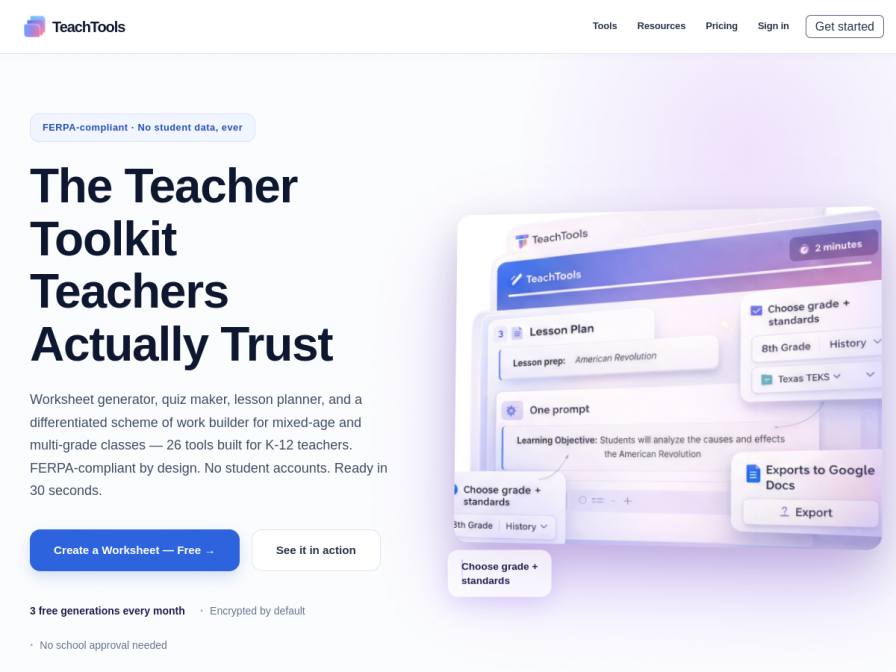
10 fictional AI personas. Exploratory perspectives, not a survey of real customers. Methodology & limitations
Simulated interest
AI synthesis, not measured demand
Suggested price range
No numeric price estimates in the answers. Ask a pricing follow-up to collect them.
Response sentiment
What this panel suggests
First-time visitors seem most interested when TeachTools quickly proves two things: it is privacy-safe for teachers, and it will actually save prep time. FERPA compliance and “no student data” read as major trust builders, especially versus generic AI tools. The strongest hesitation is not price; it is uncertainty about whether the tool can produce usable, curriculum-appropriate materials without lots of tweaking. That concern shows up as questions about how input works, whether standards/grade selection is enough, and whether the output will feel generic or require heavy editing. The page says “no prompt engineering” and “ready in 30 seconds,” but respondents still want more proof that the workflow is truly simple and that the results are classroom-ready. Some also react to the 26-tool breadth as potentially overwhelming, while others like that the tool set is focused and purpose-built. What would make them sign up is a clear demo of output quality, obvious grade/standards fit, and a low-friction trial that lets them test privacy, ease of use, and classroom usefulness before committing.
Recurring themes
“The primary draw for me is the explicit mention of being FERPA-compliant”Read Vieve Wagenaar’s response →
“What's unclear is the actual quality and customisation of the output”Read Juan Hane’s response →
“The option to pause the subscription is also a practical consideration for my budget”Read Sunita Chaturvedi’s response →
Objections to investigate
- Unclear input process for curriculum standards
- Fear of generic or low-quality AI output requiring heavy editing
- Limited utility of free tier (3 generations/month)
- Potential irrelevance for non-standard curricula (e.g., competitive exams)
Use these findings to plan customer interviews or experiments. How to interpret AI research
What the panel said
Click a name to open that persona’s full profile.
Edith KuvalisneutralAt first glance, the page seems promising, especially with its emphasis on being FERPA-compliant and having no student data collection, which is crucial for me. The "Create a Worksheet — Free →" button is clear, and the mention of 3 free generations per month is a good starting point. What's unclear is how exactly the "standards" selection works – do I need to know specific Texas TEKS codes, or will it interpret general topics? I might leave if I can't quickly understand the input process for creating a worksheet tailored to specific curriculum needs. To sign up, I'd need to see a very straightforward way to input a topic and grade level and get a usable worksheet. The promise of "No prompt engineering. No formatting headaches." is appealing, but I’d want to test that. Seeing a clear demonstration of generating a 4th-grade math worksheet with answer keys would be key.
Simulated interest: 75/100
Juan HaneneutralThe initial pitch about being FERPA-compliant and not collecting student data is certainly a hook, given the constant pressure around safeguarding. The "Teacher Toolkit" sounds promising, especially the mention of 26 tools for K-12. What's unclear is the actual quality and customisation of the output – can it produce rubrics that match our specific grading criteria, or quiz packs that aren't too generic? I'd leave if the interface felt overly complex or if it seemed like it would require extensive prompt engineering, which I don't have time for. I'd consider signing up if I could see clear examples of outputs for essay rubrics for Year 7-9 and if the 'free to start' offer genuinely allowed testing those specific features without a looming commitment or data collection.
Simulated interest: 50/100
Sunita ChaturvedineutralThe initial landing page is quite clear about what TeachTools offers – a toolkit for teachers. The emphasis on being FERPA-compliant and not collecting student data is very reassuring, given my need for privacy. What might make me hesitate initially is the sheer number of tools listed; while variety is good, it could feel overwhelming. I'd want to quickly understand which tools are most relevant to my daily tasks, like worksheet and quiz creation. To sign up, seeing a clear, quick demonstration of how the worksheet generator works, perhaps a short video showing the input and output, would be key. The promise of "ready in 30 seconds" is compelling, and if I can generate a useful worksheet for my middle school classes with minimal fuss, and export it easily to Google Docs as the page suggests, I would likely create an account to try the free tier. The option to pause the subscription is also a practical consideration for my budget.
Simulated interest: 75/100
Catherine BergerneutralWhen I first landed on TeachTools, the page seemed very professional and focused on teachers, which is good. The claim of "FERPA-compliant by design" and "No student data, ever" is a major selling point, as that's always a concern. However, I was a bit unsure about the "26 tools" – it feels like a lot, and I wondered if they were all relevant to my CE1 class or if I'd get lost in options, much like what happened with another tool I tried. The "3 free generations every month" is also quite limited, and I'd need to see if that's enough for my weekly needs, especially with my team. What would make me sign up is a clearer demonstration of how the worksheet generator can create visually appealing materials, similar to what I aim for with Canva, but faster. If I could easily create reading comprehension sheets that my students would find engaging and that I could quickly check before printing, that would be very compelling. The "Free to start" option is definitely appealing given my budget, but I'd want to feel confident that the free tier is truly useful before considering any paid plans.
Simulated interest: 50/100
Pamela Feest-SwiftneutralThe claim of "26 time-saving generators" is a bit overwhelming, though I appreciate the focus on practical tools. What isn't immediately clear is how easily I can adapt the generated materials to my specific student needs, especially since I often have to modify existing resources in Word and PDF. I would leave if I couldn't quickly see a clear path to customizing output or if it felt too generic. I would consider signing up because it's FERPA-compliant and promises no student data collection, which is crucial. The free tier with "3 free generations every month" sounds promising for trying it out, and the idea of generating materials in "30 seconds" is appealing given my time constraints.
Simulated interest: 70/100
Bernadette ZemlakpositiveWell, the name TeachTools is quite straightforward, and it says it's a 'Worksheet Generator & Time-Saving Tools for Teachers', which sounds promising. The bit about 'FERPA-compliant · No student data, ever' is really important and reassuring, as I'm always worried about that. I like that it's designed for individual teachers, so I wouldn't need to wait for school approval, which is brilliant. The fact that I can try it free with 3 generations a month is great. What might make me leave is if it's too complicated or if the free version is too limited. To make me sign up, I'd need to see that it genuinely saves me time and produces good quality materials that I can easily adapt. The 'Pro' plan at $10 per month seems reasonable if it's unlimited, especially since you can pause it.
Simulated interest: 75/100
Ibrahim DillaneutralThe name TeachTools and the claim of being a "Teacher Toolkit" are clear enough. The emphasis on FERPA compliance and no student data collection is also reassuring, as I am cautious about data privacy and do not want student information involved. However, the promise of "ready in 30 seconds" for generating materials seems a bit quick for the thoroughness I value; I would want to see the quality and accuracy of what is produced. I would likely leave if the interface felt overly complicated or if the free trial didn't allow me to test the core functionality of generating a worksheet without significant friction. To sign up, I'd want to see tangible evidence that the generated content is accurate and requires minimal editing. The ability to pause subscriptions is appealing, but the advertised price of $10 per month for unlimited documents seems reasonable if the quality is high, though I'd probably stick to the free tier initially to test it out.
Simulated interest: 40/100
Vieve WagenaarneutralThe primary draw for me is the explicit mention of being FERPA-compliant and not collecting student data, which is crucial given my own privacy concerns after switching away from a spreadsheet tracker. The idea of saving time on worksheet creation is appealing, especially for creating differentiated materials for mixed-level groups. However, I'm unclear on how the "26 time-saving generators" specifically address nuanced linguistic needs or if they simply produce generic content. The "free to start" with "3 free generations every month" is a good way to test, but I'd need to see if that's sufficient for my weekly needs. The comparison to ChatGPT is helpful, highlighting the output quality and educational focus. If the tool can genuinely produce high-quality, adaptable vocabulary worksheets and quizzes quickly, and if the free tier allows me to adequately assess its utility for my EAL students without a significant time commitment, I would consider signing up. I'd also want to understand more about how it handles different proficiency levels.
Simulated interest: 70/100
Chanakya DhawanneutralMy first thought is that the site is focused on K-12 teachers, which isn't exactly my audience. I prepare students for competitive exams, not regular school grades. What's unclear is if these tools can be customized enough for the specific syllabi we cover, especially for reasoning questions, which aren't standard school subjects. The promise of "ready in 30 seconds" sounds efficient, but I worry about the quality and relevance for my specific needs. The "free to start" is appealing, and if it can generate good question banks quickly, it might be worth exploring, but I'd need to see if it can handle more than just typical school subjects.
Simulated interest: 30/100
Karen BorerneutralThe initial impression is somewhat positive, especially the emphasis on being FERPA-compliant and not collecting student data. That's a major concern for me, given my caution with new platforms. The idea of generating materials quickly is appealing, though I do worry about the quality and the need for editing. It seems like a lot of the content generation relies on AI, and I'm not entirely comfortable with that for producing final classroom materials. The fact that I can try it for free is good, but I would need to see if the generated worksheets are truly ready for printing or if they require significant reformatting, which defeats the purpose for me. The pricing structure seems reasonable for the Pro plan at $10 per month, and the ability to pause is a plus, but I'd want to test the free tier thoroughly to see if it meets my standards before committing.
Simulated interest: 40/100
Keep exploring.
Find your next question or see which topics divide AI panels.
What would you ask next?
Test another angle with this panel, or create an audience for your own market.