
What would stop you from trying Octopodas (https://www.octopodas.com) this month? Be specific about how you handle this today. Also say the maximum you would pay per month in USD (0 if nothing).
Page reviewed
Octopoda — Persistent Memory for AI Agents
https://www.octopodas.com/ (opens in a new tab)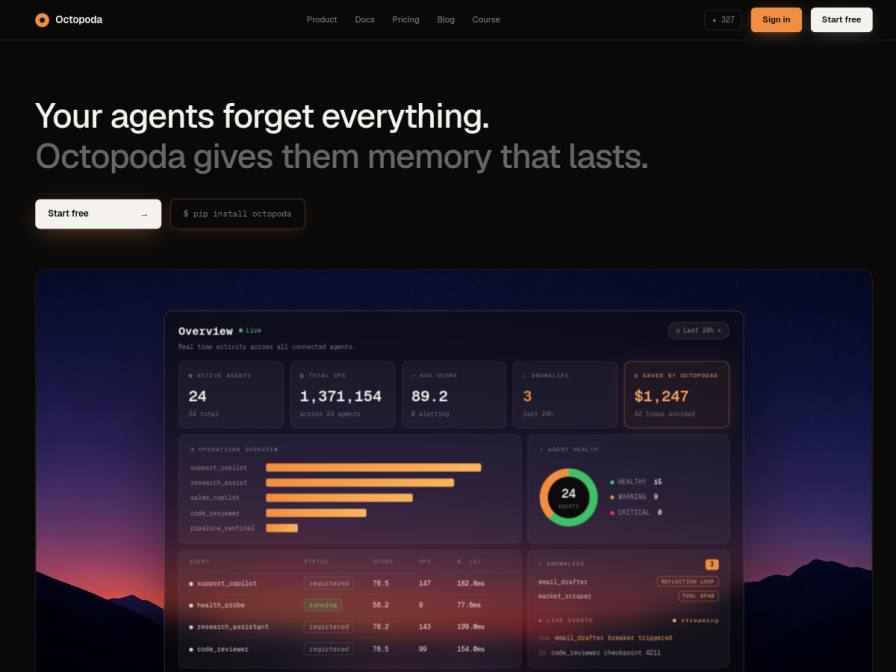
10 fictional AI personas. Exploratory perspectives, not a survey of real customers. Methodology & limitations
Simulated interest
AI synthesis, not measured demand
Suggested price range
Median $150 · simulated willingness to pay
Response sentiment
What this panel suggests
The main thing that would stop people from trying Octopodas this month is not disbelief in the concept, but uncertainty about adoption details. The clearest objection is pricing opacity: respondents want to know the tiers, what is included, and how usage is metered before they can judge value. A second major concern is integration effort and the time required to add another tool into an existing stack. Some respondents specifically wanted to understand how Octopodas would fit their current setup before committing. A third, smaller theme is that a few buyers already have workable manual processes today, such as keeping notes in Google Docs or Sheets, maintaining logs of outputs, and checking agent summaries against transcripts. That means Octopodas is competing with routines that are imperfect but already embedded. Overall, the panel sounds curious and moderately interested, but they need clearer pricing and a lower-friction path to try it without disrupting current workflows.
Pricing & positioning
Lead with a clear, usage-based or tiered monthly plan and make the first-step setup feel low risk. The strongest friction is not lack of interest, but inability to estimate ROI and uncertainty about integration time.
Respondents want explicit tiers, included features, usage metering, and enough detail to compare against their current manual process. A trial or starter tier would help reduce hesitation.
Recurring themes
“The pricing isn't immediately clear for my specific usage, which makes it hard to commit.”Read Vaijayanthi Iyer’s response →
“What might stop me from trying Octopodas this month is really understanding how it integrates with our current Postgres setup for session context.”Read Daniel Lindgren’s response →
“Right now, the biggest thing stopping me is that I'm already quite organized with my prompt notes and test cases in Google Docs and Sheets.”Read Vaijayanthi Iyer’s response →
Objections to investigate
- Unclear pricing structure
- Integration effort & time cost
- Current workaround is good enough
Use these findings to plan customer interviews or experiments. How to interpret AI research
What the panel said
Click a name to open that persona’s full profile.
Daniel LindgrenneutralWhat might stop me from trying Octopodas this month is really understanding how it integrates with our current Postgres setup for session context. We currently log notes in spreadsheets, so any solution needs to replace that workflow cleanly. The immediate need is robust memory for our agents to prevent drift, which Octopodas seems to address. The loop detection and audit trail are also appealing, especially given our focus on reliability. However, without seeing pricing details beyond 'per month subscription,' it's hard to give a concrete number. If it proves reliable and straightforward to implement, I might consider up to $150 per month.
Simulated interest: 60/100
Misty HesselpositiveThe core problem Octopodas seems to solve – agents forgetting context – is exactly what I'm wrestling with daily. My current workaround involves meticulously updating shared spreadsheets and Slack threads to track agent states, which is incredibly inefficient and fragile. The audit trail feature is particularly compelling, given my legal clients' strict compliance needs. What would stop me from trying it this month? Frankly, it's the time investment required to integrate a new tool. My team is just me and a contractor, and we're already stretched thin. I'd need to see clear, concise documentation and perhaps a quick-start guide specifically for CrewAI to feel confident about the integration effort. Regarding price, I'd be willing to pay up to $150 per month, assuming it scales well with our usage and doesn't introduce unexpected costs.
Simulated interest: 85/100
Nicolai HengmithneutralThis seems promising, particularly the persistent memory and audit trail features, which directly address my need for process clarity and traceability. Today, I handle exceptions manually in Airtable and review agent outputs meticulously in Notion, which is time-consuming. My primary concern would be how seamlessly it integrates with our existing AutoGen and Anthropic workflows, and whether the cost scales appropriately. We're currently focused on optimizing rather than expanding new tools broadly, so budget is a consideration, but the potential efficiency gains are appealing. I would need to see a clearer pricing structure beyond just 'per month' to determine a firm maximum, but initially, I could see investing up to $150 per month if it proves reliable and saves us significant review time.
Simulated interest: 70/100
Vaijayanthi IyerneutralRight now, the biggest thing stopping me is that I'm already quite organized with my prompt notes and test cases in Google Docs and Sheets. I've built a system that works for me across multiple client pilots. While persistent memory sounds useful, especially for complex agent states, I'd need to see a very clear benefit that outweighs the effort of integrating and learning a new tool. The pricing isn't immediately clear for my specific usage, which makes it hard to commit. I'd be willing to pay around $30 USD per month if it significantly streamlined my workflow or prevented costly errors, but that's contingent on understanding the exact value proposition for a solo freelancer like me.
Simulated interest: 40/100
Tristan van den BergneutralThe main thing that would stop me from trying Octopodas this month is ensuring it integrates seamlessly with our current self-hosted database stack and doesn't introduce unforeseen complexities. We currently manage agent histories and performance metrics through our shared dashboards and a paid tracing platform, so adding another layer requires careful consideration. We need to be certain it enhances, rather than complicates, our existing workflow. I'd need to see a clear benefit for our specific use cases, especially around demonstrating ROI to clients. Given the potential for improving agent consistency and audit trails, I would be willing to consider a price of $250 per month.
Simulated interest: 60/100
Rosemarie HyattpositiveThis product, Octopoda, looks promising because it directly addresses the need for an audit trail and memory for AI agents, which is a major focus for my team. What would stop me from trying it this month is the lack of clear pricing beyond "per month subscription." I need to understand the tiers, what features are included at each level, and how usage is metered. Currently, my team stores run history in SQL tables and exports logs to Excel, but an integrated solution like this could streamline that. Given the focus on audit trails and loop detection, which aligns with my goal of preventing errors and ensuring accountability, I'd be willing to pay up to $500 per month, provided it scales with our usage without unexpected spikes. I'd need to see how it integrates with our existing Python scripts and custom agents, especially since we use OpenAI and Anthropic.
Simulated interest: 75/100
Isidore DumasneutralWhat stops me from trying Octopodas this month is a lack of immediate, demonstrable need for persistent memory beyond what we currently manage, and the potential cost. We currently maintain a simple log of outputs for each project, and I meticulously verify agent summaries against transcripts. While the "brain" concept is intriguing, I'm not convinced it addresses a critical pain point for us right now. The idea of a "full audit trail" is appealing, as it aligns with my emphasis on data provenance, but I'd need to see how it integrates with our existing cloud storage. Regarding price, I would be willing to pay up to $30 per month, provided it demonstrably saves us time or prevents costly errors.
Simulated interest: 40/100
Swara BhattacharyaneutralThe biggest hesitation for me right now would be the integration and setup complexity. We've built our current system with open-source scripts and AutoGen agents, and while it works, it's a very specific setup. I'd need to understand how seamlessly Octopoda integrates with our existing AutoGen framework and if it requires significant re-architecting. Currently, we're tracking cases manually in spreadsheets and Slack, and while this is cumbersome, it's a known process. I'm also concerned about the cost; while the product promises savings, I don't have a clear breakdown of the pricing tiers and what features are included, especially for a team of our size. I would be willing to pay up to $150 per month, assuming it scales well with our usage and provides demonstrable value in reducing manual oversight and agent re-work.
Simulated interest: 60/100
Mack YostneutralThe primary thing that would stop me from trying Octopoda this month is ensuring it integrates smoothly with our current MCP and OpenAI agents. My team relies heavily on these for lead enrichment and summarization, and the 'garbage in, garbage out' principle is a constant concern. Today, we handle data consistency through manual review and prompt refinement, which is time-consuming. I'd need to see clear evidence of how Octopoda improves accuracy and reduces manual oversight. If it demonstrably solves our data integrity issues and streamlines workflows, I could see paying up to $150 per month.
Simulated interest: 60/100
Lorenzo Otero BadilloneutralThis Octopoda product sounds promising, especially the persistent memory and loop detection features, which are directly addressing pain points I encounter daily. My current setup uses a managed vector database for memory and I have custom logging for loop detection, which is a bit of a kludge but functional. The main thing stopping me this month would be time to properly integrate and test it with my existing agent architecture. I'd need to see if it can seamlessly plug into my custom MCP orchestrations and if the performance holds up against my internal dogfooding data. Pricing isn't clear here; it says 'USD per month subscription' but doesn't specify tiers. If it's comparable to my current vector DB and tracing tools, I might consider around $50 per month.
Simulated interest: 60/100
Keep exploring.
Find your next question or see which topics divide AI panels.
What would you ask next?
Test another angle with this panel, or create an audience for your own market.