
What do you use today instead of ShipAddons (https://shipaddons.com/) (a competitor, a spreadsheet, doing it by hand)? Compared with that, what would make ShipAddons better or worse for you, and what would keep you on your current option? Also say the maximum you would pay per month in USD (0 if nothing).
Page reviewed
ShipAddons – Stop Wasting 60+ Hours on Google Workspace Add-on Boilerplate | ShipAddons
https://shipaddons.com/ (opens in a new tab)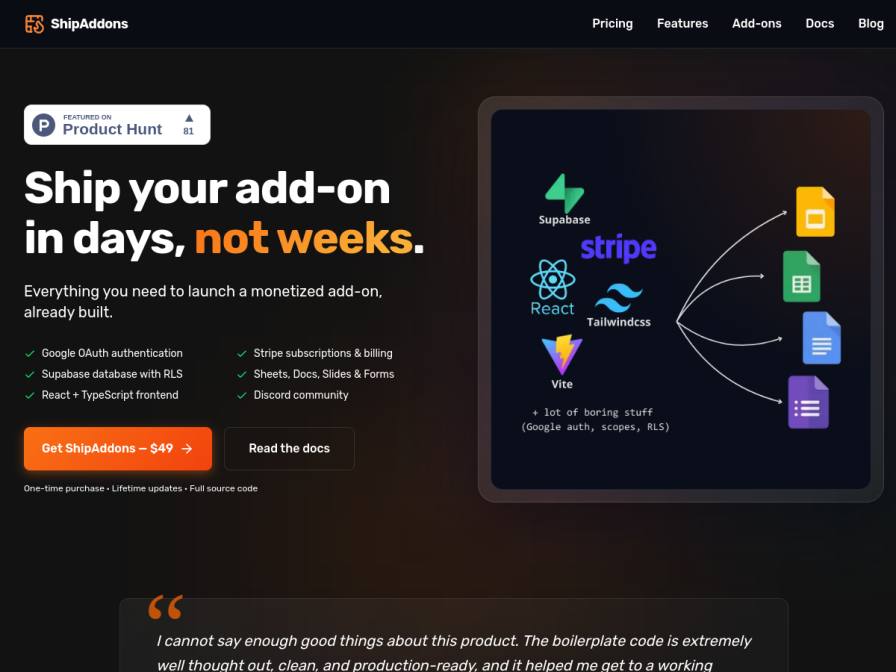
10 fictional AI personas. Exploratory perspectives, not a survey of real customers. Methodology & limitations
Simulated interest
AI synthesis, not measured demand
Suggested price range
Median $49 · simulated willingness to pay
Response sentiment
What this panel suggests
Respondents are mostly comparing ShipAddons against doing the work themselves: custom starter repositories, free snippets, and manual Apps Script or Google Workspace setup. The main appeal is not novelty, but getting past repetitive plumbing faster so they can focus on product-specific logic. In that sense, ShipAddons looks like a time-saving substitute for boilerplate rather than a replacement for deep engineering work. The strongest reasons to choose it are faster launch, less setup friction, and the appeal of a one-time purchase with lifetime updates. The strongest reasons to stay with the current approach are control and familiarity: several responses emphasize wanting deep control over unique business logic, avoiding unnecessary abstraction, and not adding dependencies that could complicate maintenance. There is also a recurring concern about whether it will fit existing architecture and custom workflows cleanly. The page claims ShipAddons is production-ready, source-code based, and includes auth, Stripe, Supabase, and multi-app support; the objections do not deny those claims, but suggest buyers remain cautious about flexibility and integration. Overall, the value proposition resonates, but only for builders who prioritize speed over bespoke control.
Pricing & positioning
Price positioning looks compatible with a small, builder-focused audience, especially if the buyer is replacing manual Apps Script setup or a custom starter repo. The strongest pull is time saved on auth, billing, and database wiring; the main barrier is concern about losing control of architecture.
The observed willingness to pay centers around $49, with a higher ceiling reaching $100 in the sample.The one-time purchase framing is aligned with the clearest positive reaction.If pricing changes, keep the value story tied to reduced setup time and source-code ownership rather than abstract convenience.
Recurring themes
“The main benefit would be speed to market, getting us past the boilerplate faster so we can focus on our unique features. The main concern would be how well it integrates with our existing architecture and whether it introduces unnecessary complexity or dependencies we can't manage.”Read Finn Bosman’s response →
“The $49 one-time purchase for lifetime updates is certainly a compelling offer.”Read Eddie Baumbach’s response →
“What keeps us on our current path is the need for deep control over our unique business logic and the risk of introducing another layer of abstraction that might complicate future maintenance.”Read Nina Wolff’s response →
Objections to investigate
- Architectural lock-in and abstraction
- Customization effort for specific workflows
- Integration with existing codebases
Use these findings to plan customer interviews or experiments. How to interpret AI research
What the panel said
Click a name to open that persona’s full profile.
Eddie BaumbachneutralRight now, I'm using my own starter repository with clasp, OAuth, and deployment scripts. It works well for me because I've refined it over time and it's tailored to my workflow. ShipAddons looks like it handles a lot of the boilerplate I've already built, like auth and Stripe integration, which is appealing. The $49 one-time purchase for lifetime updates is certainly a compelling offer. What I'd need to consider is how much actual customization it would require for my specific client needs in logistics and finance versus just rebuilding parts of it anyway. It could save me time on initial setup, but my current system is very lean and I'm hesitant to adopt something that might add overhead or lock me into a specific architecture I can't easily modify. I'd be willing to pay up to $49 for a one-time purchase.
Simulated interest: 60/100
Nina WolffneutralToday, we're essentially building and maintaining our own integration layer from scratch, which involves a lot of custom work around Supabase auth and Stripe subscriptions, as our current template isn't ideal. The idea of a pre-built boilerplate that handles these core pieces, especially for Google Workspace add-ons, is appealing. ShipAddons' promise of saving 60+ hours on auth, Stripe, and Supabase setup is a significant draw. It would be better if it offered more flexibility in customization for our specific reconciliation workflow, and worse if its structure locked us into patterns that don't scale or are difficult to refactor. What keeps us on our current path is the need for deep control over our unique business logic and the risk of introducing another layer of abstraction that might complicate future maintenance. Given the product is a one-time purchase for lifetime updates, $49 feels reasonable to evaluate its suitability.
Simulated interest: 70/100
Connor KempeneutralRight now, my partner and I handle all of our boilerplate development in-house. We maintain a shared codebase for common functionalities like OAuth and client configurations. ShipAddons seems to offer a pre-built solution for many of these components, which could save us time. However, the main challenge for us is the customization overhead for each client. While ShipAddons might handle the initial setup, I'm concerned about how much adaptation would still be needed. The $49 one-time purchase price is certainly appealing for lifetime access, especially compared to the ongoing costs of other solutions. I would consider paying up to $100 USD on a one-time basis for a product like this, provided it significantly reduces our per-client adaptation effort.
Simulated interest: 70/100
Sucheta MararpositiveToday, I build my Google Sheets add-on using free Apps Script snippets and `clasp`. I handle everything manually, from development and testing on a shared staging sheet to deployment. If ShipAddons could significantly reduce the time spent on setup for authentication, database integration, and deployment, that would be a huge advantage. However, the pricing is a one-time purchase of $49, which is appealing. I'd be willing to pay up to $49 one-time for this, as it aligns with my pragmatic approach to using tools that save significant development time, especially given the limitations I sometimes face with Apps Script.
Simulated interest: 75/100
Finn BosmanpositiveRight now, we're building our Google Docs add-on from scratch, integrating Stripe and Supabase ourselves. It's a significant chunk of work. ShipAddons promises to handle a lot of that initial setup, which is appealing. The main benefit would be speed to market, getting us past the boilerplate faster so we can focus on our unique features. The main concern would be how well it integrates with our existing architecture and whether it introduces unnecessary complexity or dependencies we can't manage. The $49 one-time purchase price seems reasonable for the potential time savings, especially if it's as production-ready as they claim. I'd be willing to pay $49 for lifetime access.
Simulated interest: 70/100
Tabitha Harber-RohanneutralToday, I'm primarily using Google Apps Script and Google Cloud for our custom add-ons. I also maintain a detailed spreadsheet for our backlog. The appeal of ShipAddons is that it seems to handle a lot of the initial setup, like authentication and Stripe integration, which are time-consuming. That could be a significant improvement over building everything from scratch. However, I'd need to see how flexible it is for our specific, often niche, workflows. The biggest hesitation would be if it adds complexity or doesn't integrate smoothly with our existing Google Workspace environment. I'd consider paying $49 as a one-time purchase for lifetime access, as that aligns with the product's offer.
Simulated interest: 70/100
Alcide PetitneutralCurrently, I manage all the authentication, billing, and release aspects of my Sheets add-on myself. It's a significant overhead, but it gives me complete control. ShipAddons appears to automate much of this, which is appealing given the time I spend on these tasks. The idea of a pre-built system for auth and Stripe is certainly tempting. However, my current setup is a standalone codebase; I would need to understand how integrating a boilerplate like ShipAddons would affect that structure and my existing logic. The one-time purchase model is interesting, but I'd need to see if the feature set truly justifies the cost over continuing to build and maintain it myself, especially considering potential future modifications. I don't have a fixed budget for this kind of tool, but I would consider up to $50 per month if it significantly reduced my current workload and offered long-term value.
Simulated interest: 60/100
Bhudev JangidneutralRight now, I stitch together solutions from free code snippets and my own utilities. It works, but it's time-consuming to handle auth and payment integrations repeatedly. ShipAddons could be better if it genuinely abstracts away the boilerplate, letting me focus on unique features. What would keep me on my current path is a steep learning curve or if the setup cost feels too high for the time saved. I need to see a clear ROI. Given it's a one-time purchase for lifetime updates, I would consider paying $49 USD per item.
Simulated interest: 80/100
Camille BalistrerineutralCurrently, we handle Google Slides and Sheets add-ons development internally, which involves a significant amount of manual setup and custom coding, especially for authentication and database integration. This process is time-consuming and requires considerable developer effort. ShipAddons appears to automate many of these repetitive tasks, potentially reducing our development time significantly. The one-time purchase model of $49 for lifetime access is very appealing, especially compared to a monthly subscription. However, I'd need to understand how easily it integrates with our existing workflows and if it supports the specific educational client requirements we often encounter. It's unclear if it handles the customisation needed for bespoke educational tools.
Simulated interest: 60/100
Izaak WojtczakneutralRight now, I'm managing auth, database migrations, and billing wiring entirely from scratch in my own repository. It's a lot of custom work, but it gives me complete control. For ShipAddons to be better, I'd need to see its code structure and understand exactly how much abstraction is involved. I'm skeptical of solutions that hide complexity. The biggest factor keeping me on my current path is that I built it myself and know its every corner. If I were to consider ShipAddons, I'd be looking at a one-time purchase rather than a monthly subscription. Given the $49 one-time price, I'd consider it if the codebase was exceptionally clean and well-documented, but I'm not willing to pay a recurring fee.
Simulated interest: 50/100
Keep exploring.
Find your next question or see which topics divide AI panels.
What would you ask next?
Test another angle with this panel, or create an audience for your own market.