
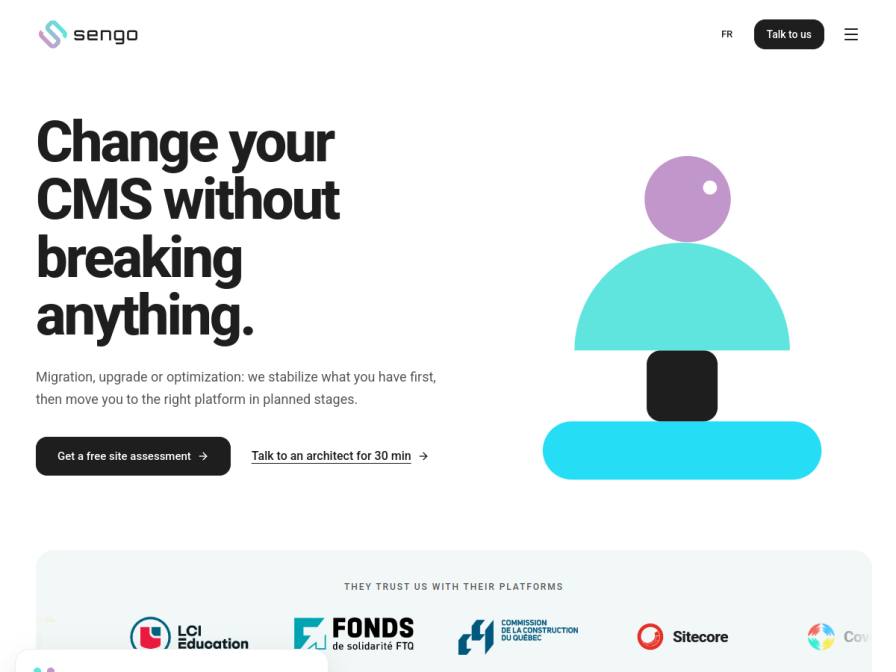
You land on https://sengo.com (Sengo) for the first time. What's unclear, what makes you leave, and what would make you sign up?
10 fictional AI personas. Exploratory perspectives, not a survey of real customers. Methodology & limitations
Simulated interest
AI synthesis, not measured demand
Suggested price range
No numeric price estimates in the answers. Ask a pricing follow-up to collect them.
Response sentiment
What this panel suggests
Prospects generally respond well to Sengo’s core promise: stabilize first, then modernize in stages, which lowers the perceived risk of CMS upgrades and migrations. That message seems to create interest because it directly addresses fear of breaking a live platform. What still feels unclear is how that approach applies to each buyer’s exact environment. Several responses ask for more specificity on supported legacy stacks and hybrid setups, with SharePoint mentioned as a representative concern; the page’s broad platform language and partner logos help, but do not fully resolve that question for everyone. Respondents also want more proof that Sengo fits their context, especially in public sector, higher education, and nonprofit settings. The current success stories are seen as useful but not yet tailored enough to those sectors. A few answers suggest they would sign up for a free diagnostic if it were clearly tied to their stack, plus transparent next steps and pricing expectations. In short, the page’s strongest draw is risk reduction; its main friction is making that promise feel concrete for a specific organization.
Recurring themes
“The concept of stabilizing first before migrating or upgrading resonates deeply given our legacy system.”Read Alice Conn’s response →
“Signing up would depend on how they handle our specific existing technologies and the transparency of their pricing.”Read Boas Rietman’s response →
Objections to investigate
- Lack of industry-specific proof points (Public Sector, Higher Ed, Nonprofits)
- Unclear technical scope regarding specific legacy stacks (e.g., SharePoint)
- Missing upfront cost estimates or pricing models
- Abstract nature of 'modernization' vs. practical application
Use these findings to plan customer interviews or experiments. How to interpret AI research
What the panel said
Click a name to open that persona’s full profile.
Joshua ZiemannneutralThe core message about modernizing CMS and intranet search without disruption is clear and directly addresses one of my persistent challenges. I appreciate the emphasis on stabilizing first before migrating. What's unclear is the specific technology stack they support, especially regarding SharePoint Online, which is central to our university intranet. I'd also want to know more about their staged approach – how granular is it, and what's the typical timeline for a large institution. To sign up, I’d need to see case studies or examples relevant to higher education or large public sector organizations, and a clear explanation of how they integrate with existing systems like ours. The offer for a free site assessment is a good first step.
Simulated interest: 50/100
Alice ConnneutralLanding on Sengo, the initial message "Change your CMS without breaking anything" immediately grabs my attention because that's precisely my daily struggle. The concept of stabilizing first before migrating or upgrading resonates deeply given our legacy system. However, it's a bit unclear *how* they achieve this stabilization without more technical detail. I'd leave if I didn't see options to understand their process better, like the "Get my free migration plan" or "Get my performance audit." To sign up, I'd need to see more concrete examples of how they've handled complex healthcare network CMS issues, perhaps case studies specific to our industry, and a clearer outline of the phased approach beyond just "stabilize, migrate, evolve."
Simulated interest: 60/100
Brad VolkmanneutralThe main thing that's unclear is how Sengo's services translate to a public sector context like ours. It mentions "customer-facing CMSs" and "intranet search," which resonates, but the examples and case studies seem more corporate. I'd leave if I couldn't quickly understand how they'd handle the complexities of a county council website with its specific needs for accessibility and citizen information, especially given budget constraints. To make me sign up for a consultation, I'd need to see clearer pathways for local government and perhaps some reassurance that their approach fits within our budget limitations. A free site assessment tailored to public sector challenges would be a good start.
Simulated interest: 60/100
Shreyashi ShuklaneutralThe initial message, "Change your CMS without breaking anything," is clear and directly addresses a significant concern for me given my role in managing a large SharePoint and Confluence environment. What's unclear is the specific technology stack Sengo works with beyond the mentioned platforms like Sitecore and Coveo, and more importantly, how they would handle the complexity of integrating with existing systems like ours. I would leave if the site didn't offer concrete examples of success in modernizing knowledge portals or if the initial assessment process seemed overly generic. To sign up, I'd want to see clear case studies of similar organizations and understand the phased approach in more detail, perhaps with a sample roadmap or a demonstration of their diagnostic tools for search relevance, as that's a key pain point for my team.
Simulated interest: 60/100
Alvin BoehmneutralThe headline, "Change your CMS without breaking anything," is clear and directly addresses a major pain point I deal with regularly. The premise of stabilizing first before migrating or upgrading also resonates, given the technical debt we're managing. What's unclear is the cost structure – there's no pricing information readily available, and while they mention "free site assessment" and "talk to an architect," I'd need to understand the investment required for any actual work. I'd consider signing up if I could get a clearer picture of their phased approach and a ballpark estimate for a project like ours, especially concerning the content fixes and template modernization.
Simulated interest: 30/100
Patricia ZboncakneutralThe headline, "Change your CMS without breaking anything," is a bit vague. I'm not entirely sure what "CMS modernization" or "Intranet Search" means in practical terms for my role. It feels a bit too abstract for someone focused on day-to-day content governance. I'd be more inclined to sign up if there were clearer examples of how this directly benefits internal communication and employee access to information, perhaps with case studies specific to insurance companies. The offer of a "free site assessment" or a "30 min talk with an architect" is appealing, as it's low risk and could provide some clarity.
Simulated interest: 30/100
Jonathan TrompneutralLanding on Sengo, the headline "Change your CMS without breaking anything" immediately caught my eye. It directly addresses a major pain point for my organization: stabilizing our current, patchwork system before making any big changes. I appreciate the phased approach they describe. What's unclear is the specific technology stack they work with beyond mentioning "the technology you already own," and what "planned stages" realistically looks like for a small nonprofit like mine. I'd be more inclined to sign up if there were clearer case studies or examples relevant to nonprofits, perhaps with some indication of pricing tiers or at least a clearer process for understanding cost, as budget is always a concern for us. The "free site assessment" and "talk to an architect" options are good starting points.
Simulated interest: 50/100
Jennie KonopelskineutralThe core message about changing a CMS without disruption is interesting, and the "stabilize first" approach resonates given my own experience with release freezes. However, it's unclear *how* they plan to modernize our existing vendor platform with custom widgets. The "Where to start?" section offers free diagnostics, which is a good entry point, but I'd need to understand their specific capabilities with our particular CMS and the limitations of custom development before considering signing up. I'm hesitant to commit to anything without seeing how they'd handle our complex needs and compliance requirements.
Simulated interest: 40/100
Boas RietmanneutralThe headline "Change your CMS without breaking anything" immediately grabs my attention, as that's precisely the challenge we face with our quarterly releases. It clearly states their approach: stabilize first, then move in planned stages. This resonates with my preference for methodical changes. What's unclear is the scope of 'planned stages' – how long does this typically take, and what are the associated costs? I'd also want to understand their process for ensuring content integrity during migration. Signing up would depend on how they handle our specific existing technologies and the transparency of their pricing. I'm wary of vendors who don't clearly outline costs upfront.
Simulated interest: 60/100
Camille LerouxneutralThe headline, "Change your CMS without breaking anything," is intriguing, but the core offering feels a bit abstract at first. I'm not sure if it's about migrating *to* a new CMS or *fixing* the one we have. My current intranet uses legacy tools and SharePoint, so the idea of modernization is appealing, especially the "stabilize first" approach. That addresses one of my biggest problems – the fear of disruption. I'd consider signing up for a free site assessment or talking to an architect if I understood better how it applies to internal intranets, not just customer-facing CMSs. Clarity on the intranet search aspect is also key, as that’s a major pain point for us.
Simulated interest: 50/100
Keep exploring.
Find your next question or see which topics divide AI panels.
What would you ask next?
Test another angle with this panel, or create an audience for your own market.