
What do you use today instead of ScanETF (https://scanetf.com/) (a competitor, a spreadsheet, doing it by hand)? Compared with that, what would make ScanETF better or worse for you, and what would keep you on your current option? Also say the maximum you would pay per month in USD (0 if nothing).
Page reviewed
ScanETF — Rayon X : analysez, optimisez et suivez vos ETF
https://scanetf.com/ (opens in a new tab)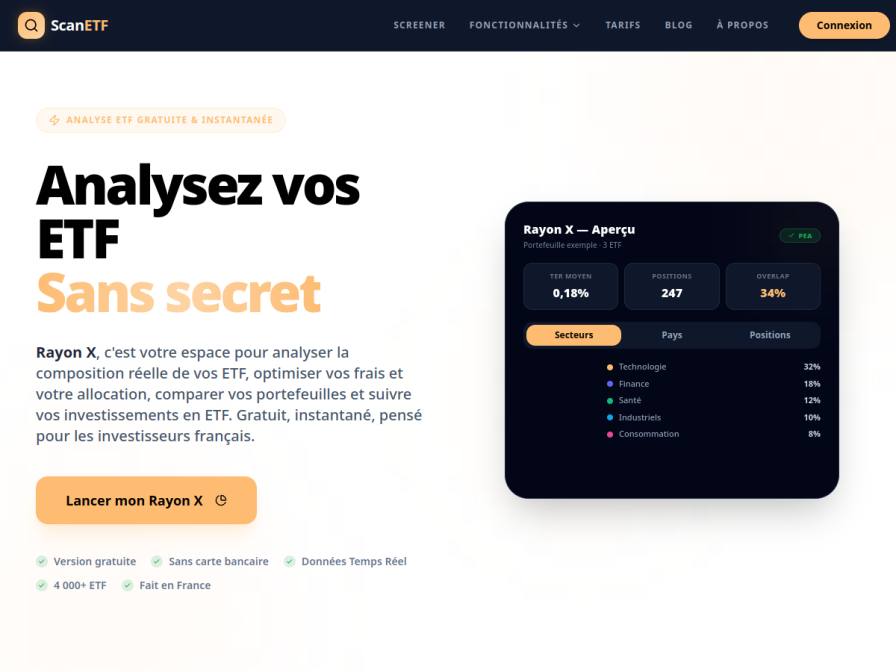
10 fictional AI personas. Exploratory perspectives, not a survey of real customers. Methodology & limitations
Simulated interest
AI synthesis, not measured demand
Suggested price range
Median $12.5 · simulated willingness to pay
Response sentiment
What this panel suggests
Most respondents are not using a competing ETF platform; they mainly rely on spreadsheets, Google Sheets, and manual updates after buys. That makes ScanETF attractive because it promises to automate the annoying parts of ETF management: composition analysis, overlap detection, TER/fee calculations, and portfolio comparison. The clearest positive reaction is to time savings and better visibility into what is actually inside a portfolio. However, the dominant hesitation is not feature skepticism so much as perceived fit. Several respondents read the product as primarily aimed at French investors, especially because of the emphasis on PEA eligibility, and worried that this would not help with UK ISA, US taxable, or other international accounts. The page itself says the tool is built for French investors, while also claiming a 4,300+ ETF screener, so the main issue is clarity about scope rather than lack of functionality. Some would stick with their current workflow because it is free and familiar, and because they want reassurance about coverage and accuracy before switching. Pricing tolerance is modest, with a low-teens monthly ceiling appearing more plausible than a premium subscription.
Pricing & positioning
Lead with a low-friction self-serve offer and make the non-French use case unmistakably clear if you want to expand beyond French ETF investors. The strongest pull is convenience: replacing spreadsheets and manual overlap/fee checks. If the product remains framed as France-first, conversion will likely depend on a narrower segment of French DIY investors.
The observed willingness to pay is modest: the median sits in the low teens, with some answers at 0 when the product feels irrelevant. That suggests a low-cost tier is more plausible than premium pricing, unless ScanETF can prove broad coverage, accuracy, and clear time savings. A simple monthly plan in the low-to-mid teens is the clearest fit from this batch.
Recurring themes
“Currently, I maintain my ETF portfolio using a spreadsheet that I update manually after each monthly contribution.”Read Alfredo Pfeffer-Zemlak’s response →
“The automated detection of overlaps and fee analysis is also compelling.”Read Alfredo Pfeffer-Zemlak’s response →
“However, my primary concern is the product's focus on French investors and PEA eligibility, which isn't directly relevant to my UK ISA and taxable accounts.”Read Alfredo Pfeffer-Zemlak’s response →
“I'd need to see how it handles US-specific funds and if it genuinely simplifies things without obscuring data.”Read Muriel Franey’s response →
Objections to investigate
- Perceived mismatch for non-French investors
- Existing free/manual tools are sufficient
- Unclear scope for international or non-UCITS funds
Use these findings to plan customer interviews or experiments. How to interpret AI research
What the panel said
Click a name to open that persona’s full profile.
Alfredo Pfeffer-ZemlakneutralCurrently, I maintain my ETF portfolio using a spreadsheet that I update manually after each monthly contribution. I meticulously track overlap, fees, and sector balance. The appeal of ScanETF lies in its potential to automate this detailed analysis, particularly the granular composition of holdings and real-time exposure to specific industries, which is a significant time sink for me. The automated detection of overlaps and fee analysis is also compelling. However, my primary concern is the product's focus on French investors and PEA eligibility, which isn't directly relevant to my UK ISA and taxable accounts. I would need to understand how well it translates to my specific situation. If it could accurately provide the deep dive into my UK-listed ETFs that I'm looking for, I might consider a nominal fee, but I'm not willing to pay for features I don't need. Given the focus on French investors, I'm hesitant about the value proposition for my specific needs.
Simulated interest: 30/100
Muriel FraneyneutralRight now, I'm manually tracking my ETF holdings in Google Sheets. It's quite a process, taking up valuable weekend time. ScanETF seems like it could streamline the expense ratio and regional exposure analysis, which is a huge time saver. The AI assistant feature sounds interesting, though I'd need to see how it handles US-specific funds and if it genuinely simplifies things without obscuring data. The biggest hurdle would be if it's not as granular or transparent as my current method, or if it tries to push specific ETFs. I'm willing to pay up to $10 per month for a tool that demonstrably saves me time and provides clear, actionable insights.
Simulated interest: 50/100
Triloki Nath ChattopadhyayneutralToday, I meticulously manage my portfolio using Excel. I cross-reference allocations and factsheets manually. ScanETF's ability to provide a consolidated view of ETF composition and detect overlaps sounds promising, as finding reliable data for international UCITS funds accessible in India is a challenge. However, the primary focus of ScanETF seems to be for French investors, particularly with its PEA eligibility checks. I'm uncertain how well it would cater to my specific needs regarding Indian equity ETFs and UCITS funds available to me. The pricing isn't clearly stated for general access, only a general mention of tariffs, making it hard to commit. I would be willing to pay up to $10 per month if it demonstrably solves my data aggregation and analysis problems for my specific ETF basket.
Simulated interest: 40/100
Elly SchwalmneutralCurrently, I export my brokerage statements and meticulously review them using justETF-style comparison tools to identify portfolio overlap and index exposure. This process is manual but gives me the clarity I need. ScanETF's promise of an automated 'Rayon X' for composition, overlap detection, and TER calculation is appealing. The AI assistant and API access are interesting, but my primary concern is the accuracy and comprehensiveness of the data for UCITS ETFs, as the site seems heavily geared towards French investors and PEA eligibility. If it reliably offers granular insights into my existing holdings, it could be a valuable addition. However, I am not willing to pay for a subscription at this time, as my current method, while time-consuming, is sufficient and free.
Didier LeclercneutralCurrently, I manually update my homemade dashboard with data from various sources, which is quite time-consuming. ScanETF's automated analysis of ETF composition, overlap detection, and TER calculation would be a significant improvement. However, the product description mentions an API, which is intriguing for my data engineering background, but the details are somewhat vague regarding its capabilities for free data feeds. If the API could reliably provide granular data to automate my dashboard's current functions, it would be valuable. I would be willing to pay up to $15 per month for such an API, assuming it meets my needs for data accuracy and automation.
Simulated interest: 60/100
Deborah DietrichneutralI currently use Google Sheets to track my ETFs, comparing the data with my broker's free breakdowns and factsheets. It's quite time-consuming, I'll admit. ScanETF sounds intriguing, especially the automatic detection of overlaps and the clarity it offers on holdings. However, I'm very comfortable with my current method, and I've never paid for a portfolio tool before. The biggest hurdle would be convincing me that the time saved is worth more than the cost, especially with my modest investment budget. If it could genuinely save me hours each month and reveal significant cost savings or risks I'm missing, I might consider it. For now, I wouldn't pay anything per month.
Simulated interest: 20/100
Jeremiah MannneutralCurrently, I manage my portfolio using a combination of spreadsheets and manual checks against free screening sites. It's a meticulous process, but it gives me the granular control I prefer. ScanETF's ability to automatically detect overlap and analyze composition is appealing, as it addresses a significant time sink in my current method. However, the core functionality seems focused on French investors, specifically with PEA eligibility, which isn't directly relevant to my US-based accounts. I'd need to understand how the broader analytical capabilities translate to my situation, especially regarding factor tilts and expense ratio comparisons. If it offers robust, US-centric analysis beyond basic overlap and composition, I might consider it. I would not pay for this service given my current setup and its apparent focus.
Juna MolneutralToday, I manually import my DEGIRO transactions into a detailed Excel spreadsheet and then cross-reference this with another analytics site. ScanETF could be better if it offered a more integrated view and truly automated my workflow without requiring manual data entry. The risk of overlap detection not being perfect is a concern, as is the complexity of the platform for my needs. The biggest draw is the potential to save time and gain clearer insights, but I'm hesitant about subscription costs. Given the manual effort I currently exert, I might consider paying up to $15 per month if it genuinely solves my current frustrations and offers transparent data.
Simulated interest: 50/100
Sofia RagoneneutralCurrently, I meticulously review my broker statements and ETF fact sheets manually. The primary challenge is the sheer time commitment required for this level of detail, especially concerning fund domicile and currency exposure. ScanETF's promise of analyzing ETF composition, optimizing fees, and detecting overlaps is appealing, as it could significantly streamline this process. However, it is primarily designed for French investors, focusing on PEA eligibility, which is not directly applicable to my situation as an Italian investor. My primary concern would be the relevance and accuracy of its analysis for my specific portfolio, given the international regulatory landscape. I am willing to pay up to $20 per month for a tool that demonstrably saves me time and provides accurate, actionable insights relevant to my investment strategy, provided it addresses my specific needs regarding currency exposure and domicile.
Simulated interest: 50/100
Jeff VolkmanneutralCurrently, I use a combination of spreadsheets and broker exports to manage my portfolio. It’s a bit manual, but I find it gives me the precise control I need. The idea of ScanETF showing the "real composition" and "overlap" sounds intriguing. If it could genuinely save me time and provide deeper insights into my ETF holdings than my current method, that would be a significant improvement. However, I'm hesitant about adding complexity or cost, especially if it’s primarily designed for French investors with specific tax considerations like the PEA. My current system is free, and while it takes time, it's predictable. I'm not sure I'd pay for this service, given my current process. If there were a robust free tier that truly simplified my analysis without requiring manual data input that I can already manage, perhaps. But a monthly subscription? Unlikely. I'd say $0.
Keep exploring.
Find your next question or see which topics divide AI panels.
What would you ask next?
Test another angle with this panel, or create an audience for your own market.