
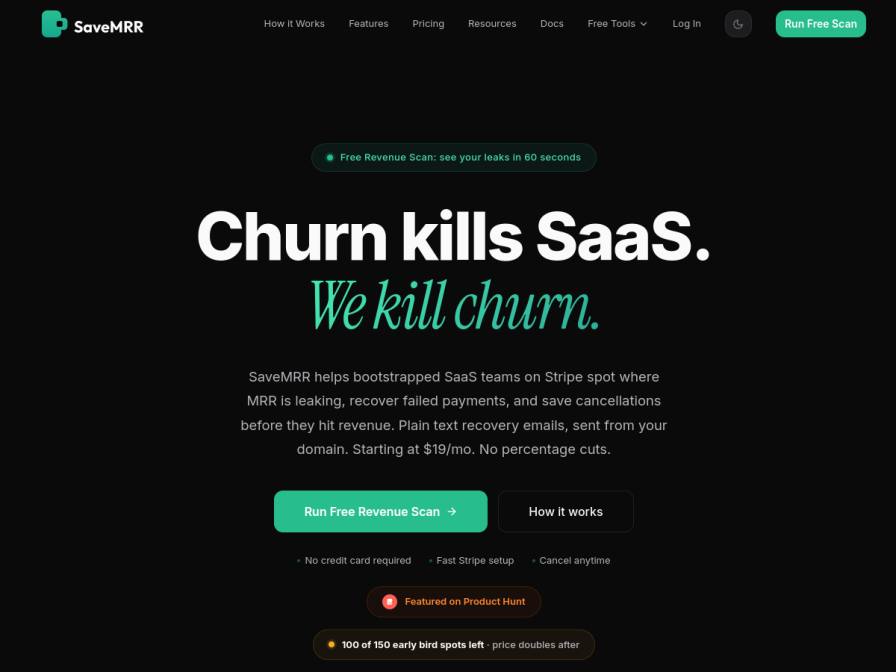
What would stop you from trying SaveMRR (https://savemrr.co/) this month? Be specific about how you handle this today. Also say the maximum you would pay per month in USD (0 if nothing).
10 fictional AI personas. Exploratory perspectives, not a survey of real customers. Methodology & limitations
Simulated interest
AI synthesis, not measured demand
Suggested price range
Median $50 · simulated willingness to pay
Response sentiment
What this panel suggests
The responses are broadly neutral and pragmatic: buyers are not rejecting SaveMRR on principle, but they are comparing it against current hands-on workflows. Today, they handle failed payments and cancellation saves manually, often by exporting Stripe data into Google Sheets or auditing Stripe logs in Notion, then sending tailored outreach themselves. The biggest blockers this month are implementation effort, workflow disruption, and uncertainty about whether automation can preserve the personalized touch they already provide. The JavaScript requirement for Cancel Shield is a specific friction point, especially for teams that are already stretched thin. Respondents also want evidence that the product will quickly improve revenue recovery and churn reduction before they spend time integrating it. On price, the synthetic panel indicates a willingness to pay in the roughly $39–$50/month range, which aligns with a small-team SaaS tool if the ROI is clear. The strongest go-to-market angle is a lightweight, low-risk pilot that shows results quickly and fits into existing Stripe-led operations.
Pricing & positioning
Lead with a low-friction audit and a fast proof-of-value pilot. The clearest fit is for SaaS teams already handling churn manually in Stripe, Sheets, or Notion. Emphasize setup speed, clear reporting, and that the product complements existing personal outreach rather than replacing it.
The stated ceiling clusters around $39 to $50 per month. Pricing resistance appears tied more to setup effort and uncertainty about payback than to the subscription price itself.
Recurring themes
“My current process for failed payments involves manually exporting data from Stripe, merging it with our dunning outcomes in Google Sheets, and then I personally send tailored save emails.”Read Marion Jacobi’s response →
“Integrating another system requires time that is already stretched thin.”Read Sweta Khan’s response →
“We'd need to see a clear and immediate impact on revenue recovery and churn reduction to justify the effort.”Read Sweta Khan’s response →
“I'd need to understand how it integrates and if it can truly replicate the personalized touch I currently apply.”Read Marion Jacobi’s response →
Objections to investigate
- Existing tool/process lock-in
- Implementation effort vs. current bandwidth
- Fear of losing personalization control
- Technical integration hurdles (JS snippet)
- Need for clear ROI evidence
Use these findings to plan customer interviews or experiments. How to interpret AI research
What the panel said
Click a name to open that persona’s full profile.
Marion JacobineutralMy current process for failed payments involves manually exporting data from Stripe, merging it with our dunning outcomes in Google Sheets, and then I personally send tailored save emails. This is time-consuming, as you can imagine, especially with our lean team. While SaveMRR's automation for recovery and cancellation saving seems promising, I'd need to understand how it integrates and if it can truly replicate the personalized touch I currently apply. It's also unclear how the 'AI cancel insights' would work with our specific customer base. I'm willing to consider a price of $50 per month, billed annually, if it proves to be significantly more efficient and effective than my current manual approach.
Simulated interest: 60/100
Elaine BorerneutralThe main thing that would stop me from trying SaveMRR this month is my existing third-party dunning tool. While I'm wary of 'black box' solutions, I need to ensure its capabilities fully align with our current process. Currently, I manually audit Stripe logs in Notion and coordinate closely with our support team on cancellation saves. I'd need to see how SaveMRR integrates and if it offers more transparency than our current setup. If it proves to be truly transparent and effective, I might consider a price point of $50 per month.
Simulated interest: 50/100
Julian FuhlbrüggeneutralThe main thing stopping me is the time commitment to evaluate a new tool. My current process, while manual, is integrated into my weekly routine. I track failed payments in Excel and run card retries from there. Preparing the churn notes for the founder also takes considerable time. While automation is appealing, I would need to be convinced of its efficiency and cost-effectiveness compared to my established system. We have a budget of around €300 per month for new software, but that would need careful justification for the founder.
Simulated interest: 40/100
Sweta KhanneutralMy main concern with trying SaveMRR right now is the bandwidth we have for another tool. I personally handle churn and delinquency reviews in Mixpanel and Sheets, and I also send manual save emails from our support inbox. Integrating another system requires time that is already stretched thin. We'd need to see a clear and immediate impact on revenue recovery and churn reduction to justify the effort. The pricing model starts at $19/mo, which seems reasonable, but I'd need to see a concrete ROI before committing to more than $40 per month.
Simulated interest: 60/100
Elijah de CorteneutralThe primary concern for me would be how seamlessly it integrates with our existing workflows. Currently, my team relies heavily on Stripe and Intercom data, with Zapier automations and a shared spreadsheet for follow-ups. While SaveMRR promises to automate some of this, I'd need to understand how it complements, rather than disrupts, our current system. Specifically, how does it handle the nuances of customer reasons for cancellation that we try to capture manually? Also, the pricing structure for the 'Starter' plan at $19/mo seems reasonable, but I'd want to ensure it scales appropriately as we grow, and understand what the next tier truly offers. My maximum would be $50 per month.
Simulated interest: 60/100
Almine BourgeoisneutralMy current process involves a monthly reconciliation of my competitor's recovery reports against Stripe exports, followed by personally drafting win-back emails. I'm hesitant to adopt another tool without clear evidence of its accuracy and how it complements, rather than replaces, my existing due diligence. The fact that I still personally handle win-backs suggests I'm looking for something that truly enhances, not just automates, a process I already manage with a high degree of personal oversight. The pricing structure seems reasonable, starting at $19/mo, but I'd need to see how it directly impacts my specific recovered MRR figures before committing. I'd pay a maximum of $49 per month.
Simulated interest: 30/100
Lorene StantonneutralWhat would stop me? Honestly, it's the sheer volume of tools I'm already juggling. I spend a good chunk of my day in Airtable and Stripe, reconciling failed payments and sending win-back messages manually. I'm constantly looking for ways to automate, but adding another platform requires careful integration and learning. I'd need to see how seamlessly it fits with my current Airtable workflows and how much manual setup is truly involved beyond connecting Stripe. The 'Cancel Shield' requiring a JavaScript snippet is a bit of a hurdle for me, as I'd need to coordinate with our developer, which isn't always quick. Right now, I handle failed payments by retrying them through Stripe and then manually reaching out if that fails. Cancellations are tagged in Airtable, and win-backs are personalized emails I draft myself. The maximum I would pay is $49 per month.
Simulated interest: 60/100
Angelo Kemmer-TrantowneutralWhat would stop me? Honestly, the fact that I'm drowning in spreadsheets trying to manually track this. Our company is cash-conscious, and we don't have a dedicated budget for this kind of stack. I currently pull data from Stripe webhooks, crunch it in Amplitude, and then manually update a spreadsheet of failed renewals and lost customers. It's time-consuming and prone to error. The idea of automating that is appealing. The pricing starts at $19/mo, which seems reasonable, but I'd need to see how much revenue it actually recovers for us first. Given our budget constraints, I'd be looking at the lowest tier, perhaps $39/mo if it proved its value.
Simulated interest: 70/100
Guillermina Pagan CarreroneutralCurrently, my team uses a low-code workflow to log failed Stripe invoices into Notion. We then manually review these entries to address payment issues. While this system works, it's quite time-consuming and prone to oversight. SaveMRR's promise to automate failed payment recovery and offer cancellation protection is appealing. However, I'd need to understand how it integrates with our existing Notion setup and what level of customization is available for the dunning emails. I would consider paying up to $50 per month for a solution like this, provided it demonstrably reduces our administrative burden and churn.
Simulated interest: 70/100
Mateusz MarkowskineutralMy primary concern is integration and proven value. We currently manage failed payments and customer re-engagement through a combination of manual spreadsheet analysis and direct outreach by our support team. This process, while labor-intensive, allows for a level of human judgment that I believe is crucial. I would need to see clear evidence that SaveMRR can seamlessly integrate with our existing workflows and demonstrate a quantifiable improvement over our current method before considering it. The pricing structure seems reasonable for the features offered, but I would need to see a significant ROI before committing. Therefore, the maximum I would consider paying is $50 per month.
Simulated interest: 30/100
Keep exploring.
Find your next question or see which topics divide AI panels.
What would you ask next?
Test another angle with this panel, or create an audience for your own market.