
What do you use today instead of Quietflame (https://getquietflame.com/) (a competitor, a spreadsheet, doing it by hand)? Compared with that, what would make Quietflame better or worse for you, and what would keep you on your current option? Also say the maximum you would pay per month in USD (0 if nothing).
Page reviewed
QuietFlame — Guided breathing & calm focus
https://getquietflame.com/ (opens in a new tab)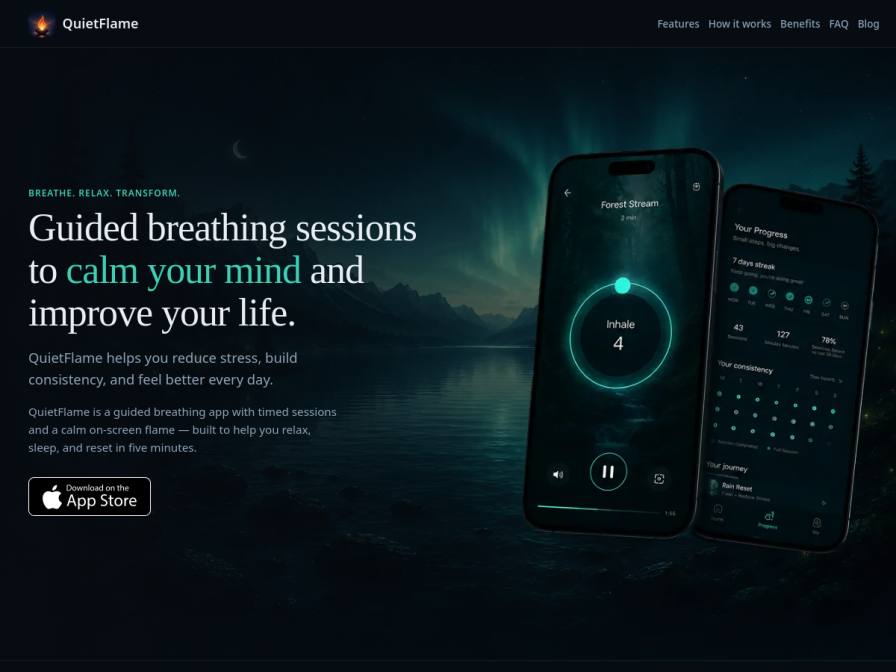
10 fictional AI personas. Exploratory perspectives, not a survey of real customers. Methodology & limitations
Simulated interest
AI synthesis, not measured demand
Suggested price range
Median $4 · simulated willingness to pay
Response sentiment
What this panel suggests
Most prospects already have a workable alternative: counting breaths, using YouTube timers, relying on Apple Watch breathing features, or tracking breaks with spreadsheets and Notion checklists. QuietFlame’s realistic candle flame and minimal design are noticed positively, but mostly as a pleasant interface rather than a must-have replacement. The biggest objection is not to breathing itself; it is to paying for something that feels close to a free, zero-cost routine that already works. QuietFlame would look better if it made guided sessions, calming visuals, or progress tracking feel meaningfully easier or more effective than those existing methods. It would look worse if the subscription seemed like a premium wrapper around a task users can already do by hand. Some respondents also mentally compared it with Calm and wanted a clearer reason QuietFlame is better for their specific need. The page says QuietFlame is free to download with premium unlocking more sessions, scenes, and sounds, but respondents still asked whether the free version and premium value are enough to justify a subscription. Overall, the issue is value clarity and differentiation, not lack of interest in the concept itself.
Pricing & positioning
Keep monetization light and value-led: a free tier plus a low-cost subscription is the most plausible fit for this audience, but only if QuietFlame clearly beats counting breaths, timers, or existing meditation apps for calmness, convenience, or consistency.
Observed willingness to pay is modest: sample low $0, median $4, high $5 per month. That suggests many prospects will need a strong reason to subscribe rather than rely on free/manual alternatives.
Recurring themes
“Right now, I just count my breaths. It's a free, zero-cost method that works fine”Read Patrick Monahan’s response →
“I'm not sure if it offers more than Calm currently does for my specific need”Read May Keeling’s response →
Objections to investigate
- Sufficiency of Free Tools
- Lack of Differentiation from Competitors
- Integration with Existing Workflows
Use these findings to plan customer interviews or experiments. How to interpret AI research
What the panel said
Click a name to open that persona’s full profile.
May KeelingneutralCurrently, I use the Calm app for short breathing exercises between meetings. QuietFlame's visual candle flame sounds appealing for its aesthetic and simplicity, which could be a nice alternative for a quick reset. However, I'm not sure if it offers more than Calm currently does for my specific need of a 5-minute pause. The tracking and streaks are interesting for habit building, but I primarily use my current app for immediate stress relief during the workday. I'd be willing to pay around $3-$5 per month if it offered a distinct advantage or a more engaging experience than what I already have.
Simulated interest: 40/100
Patrick MonahannegativeRight now, I just count my breaths. It's a free, zero-cost method that works fine during those intense incident calls. The idea of paying for an app to tell me to breathe feels counterintuitive, especially when I can just step away from my screen for two minutes. If Quietflame offered something truly unique that I couldn't replicate with just counting or looking at something physical, maybe. But honestly, paying for a subscription for a breathing timer seems like a hard pass. I wouldn't pay anything per month.
Simulated interest: 0/100
Manisha BandopadhyayneutralCurrently, I use a mix of YouTube timers and my Google Sheets to coordinate our team’s reset breaks. The 5-minute 'flame breaks' are literally just a looping candle GIF paired with a Slack reminder. QuietFlame’s guided breathing sessions sound appealing because they’re more structured and visually calming than my makeshift solutions. The progress tracking and different session goals could also help make these breaks more engaging for my team. However, I’d need to ensure it’s compatible with our hybrid setup and doesn’t disrupt our existing calendar blocks. The app’s design and guided elements might be worth $2-$3 per user per month, but only if we can try it risk-free first. Right now, my budget prioritizes tools that integrate into our existing systems, so I’d need proof it’s a net improvement.
Simulated interest: 50/100
Felicia KoubaaneutralCurrently, I use my Apple Watch's breathing exercise or a free web timer for quick resets between tasks. QuietFlame's visual candle flame sounds appealing for focus, and the tracking feature might help build consistency. However, I'm unsure if it offers significantly more than what I already use for free, especially for short breaks. The main draw would be if it feels more immersive or calming. I'm not sure I'd pay for it, but if it were exceptionally well-designed and integrated, perhaps up to $3 per month.
Simulated interest: 30/100
Boas JansenneutralCurrently, I use Insight Timer for my breathing exercises, which I find excellent for setting a calm tone before work or during travel. The visual aspect of QuietFlame, particularly the realistic candle flame, is appealing, and I appreciate the focus on short, timed sessions. It could be better if it offered more advanced tracking or integration with other productivity tools, though I'm not sure if that's within its scope. The main thing that would keep me with Insight Timer is its established functionality and the variety of content it already offers. I'd be willing to pay around $5 per month, but ideally, it would be part of a bundle or a one-time purchase.
Simulated interest: 40/100
Chatur ReddyneutralRight now, I use a manual checklist in Notion, with a short breathing reset before our daily standups. It's a custom routine for my team. The main thing QuietFlame offers that I don't have is structured, guided sessions and progress tracking for consistency. My current setup is free, though. For QuietFlame, the visual candle flame is a nice touch, but honestly, the core value would be if it significantly improved my team's focus or reduced their stress more effectively than our current method. I'd need to see that impact before considering payment. I wouldn't pay for this.
Simulated interest: 0/100
Kara McClureneutralRight now, I use the basic breathing tool on my phone, and I also rely heavily on our shared team spreadsheet to track breaks and escalations, especially during shift changes. It's just part of the daily routine, not really a separate project. What would make something like Quietflame better is if it seamlessly integrated with my existing tools or offered a very clear, tangible benefit beyond just a visual timer. Frankly, the spreadsheet works because it's already there and serves multiple purposes. I'd need to see how this is significantly different or more effective than what I'm already doing, especially considering my focus on efficiency and established processes. I'm not sure I'd pay for an app like this, as I'm quite frugal. Perhaps $0 per month.
Dianna BlandaneutralRight now, I just use free YouTube videos and my phone's timer. It works well enough for me before exams or after long library sessions. QuietFlame's candle flame sounds nice and the progress tracking could be useful, but I'm not sure if it's worth paying for. I'd need to see if the free version offers enough to justify a subscription. Honestly, my budget is really tight, so unless it genuinely solves a major problem or significantly reduces my stress, I'll probably stick with what's free.
Simulated interest: 20/100
Rebecca VasseurpositiveToday, I manage our short guided breathing pauses by setting reminders in my personal calendar and verbally cueing the team during our all-hands meetings. It's quite manual. QuietFlame sounds lovely, especially the visual candle flame, which would be a much calmer experience than my current spreadsheet-based reminders. It would be better because it's designed for this purpose and offers progress tracking, which I struggle to measure now. It might be worse if it's difficult to integrate into our meeting flow or if the cost becomes prohibitive. I would consider paying up to $5 per month for a tool like this, as our nonprofit has a very limited budget for HR initiatives.
Simulated interest: 75/100
Magnus Björklund LundneutralCurrently, I use a competitor meditation app for short breathing exercises between client workshops or during travel days. I find it adequate for quick resets. What would make QuietFlame better would be if it offered more variety in session types or perhaps integration with my digital task management tools, like Asana. What might keep me on my current option is if QuietFlame doesn't demonstrably offer a significant improvement in stress reduction or focus. I would be willing to pay up to $3 per month for a premium subscription.
Simulated interest: 40/100
Keep exploring.
Find your next question or see which topics divide AI panels.
What would you ask next?
Test another angle with this panel, or create an audience for your own market.