
What do you use today instead of Murmur (https://www.murmurtts.com/) (a competitor, a spreadsheet, doing it by hand)? Compared with that, what would make Murmur better or worse for you, and what would keep you on your current option? Also say the maximum you would pay per month in USD (0 if nothing).
Page reviewed
Local Text-to-Speech App for Mac | Murmur
https://www.murmurtts.com/ (opens in a new tab)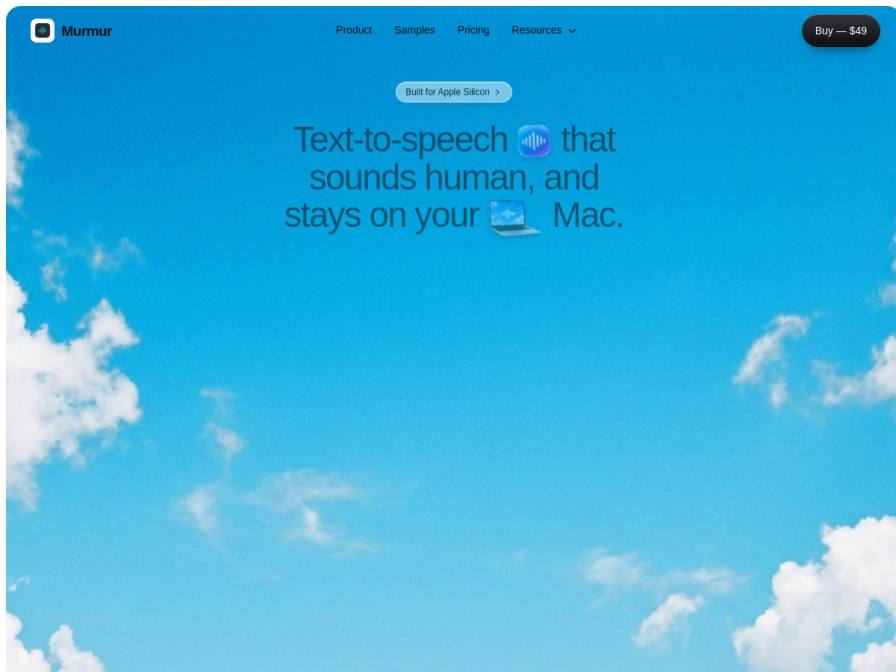
10 fictional AI personas. Exploratory perspectives, not a survey of real customers. Methodology & limitations
Simulated interest
AI synthesis, not measured demand
Suggested price range
Median $49 · simulated willingness to pay
Response sentiment
What this panel suggests
Respondents mainly replace Murmur with manual voice recording, basic robotic TTS, or cloud voice tools. Murmur is more attractive when it removes recurring costs, keeps scripts and audio on-device, and offers cloning or custom voice design. Those are the clearest reasons to switch away from current options. What would make it worse is weak voice naturalness, friction from Apple Silicon and 16 GB memory requirements for cloning, or any perceived mismatch between “local/offline” messaging and the mention of periodic license validation. That last point reads as a clarity concern: the product page says generation runs locally after setup, while some respondents still worry about hidden cloud dependence. What keeps people on their current option is simple reliability: if today’s tool already sounds better, is easier to run, or avoids setup/hardware constraints, they may not move. Reported max willingness to pay was $49, which fits the product’s value framing, though the appeal is strongest as a one-time alternative to subscriptions rather than a monthly service.
Pricing & positioning
Lead with a one-time purchase model for Mac users who want local text-to-speech, and make the voice-quality demo and hardware requirements very explicit.
Reported willingness to pay clusters at $49, but the strongest appeal is the avoidance of ongoing subscriptions and per-character fees. The pricing story should emphasize perpetual value and make clear that cloning and voice design require compatible Apple Silicon hardware.
Recurring themes
“Not having a subscription or per-word fees is a significant advantage”Read Heather Adams’s response →
“align with my preference for data privacy”Read Rene Kozey’s response →
“ensuring the quality and naturalness of the cloned voices meet my professional standards”Read Heather Adams’s response →
Objections to investigate
- Voice quality and naturalness may not be good enough
- Hardware constraints, especially 16GB RAM for cloning
- Offline/local claims feel ambiguous because of license validation
Use these findings to plan customer interviews or experiments. How to interpret AI research
What the panel said
Click a name to open that persona’s full profile.
Heather AdamspositiveCurrently, I'm using a combination of my own voice recordings and standard text-to-speech tools, which sometimes feel a bit robotic for narration. The ability to clone my voice or design custom ones with Murmur is very appealing, as is the one-time purchase model. Not having a subscription or per-word fees is a significant advantage, especially given my freelance income variability. The main drawback would be ensuring the quality and naturalness of the cloned voices meet my professional standards for client work. If it truly delivers on sounding human and stays local on my Mac, the $49 one-time cost seems very reasonable.
Simulated interest: 75/100
Rene KozeypositiveCurrently, I use a mix of free TTS tools and a paid competitor, sometimes doing manual voiceover work for specific revision requests. Murmur's local processing and one-time purchase model are appealing as they align with my preference for data privacy and predictable costs, avoiding the subscription treadmill. The key for me would be the quality and naturalness of the generated voices, especially for cloned voice pickups. If it consistently matches or exceeds my current paid tools in quality and speed, and offers the depth of customization I need for alt-reads, it's a strong contender. What would make it worse is if the voice quality is subpar or if cloning is difficult or unreliable. The biggest factor keeping me on my current options would be if Murmur's output feels robotic or if it requires significant post-processing to sound presentable. Given it's a one-time purchase, I'd be willing to pay up to $49 USD one-time.
Simulated interest: 75/100
Jonas DeerbergneutralToday, I write my scripts in Markdown and then assemble the audio myself on my MacBook Pro, keeping support assets separate. Murmur's promise of local processing and unlimited generation is appealing, especially given my focus on privacy and avoiding recurring fees. The idea of voice cloning is interesting for creating consistent tutorial audio. However, I'd need to understand how well it integrates with my current Markdown workflow and whether the voice quality and speed are sufficient for my needs without being too resource-intensive. The one-time purchase is a significant draw.
Simulated interest: 60/100
Pélagie GarciapositiveCurrently, I don't use a specific tool for generating audio drafts from scripts; I essentially do it manually by reading aloud and recording myself, which is time-consuming. The idea of a tool that turns scripts into natural speech on my Mac is appealing, especially the one-time purchase model. It sounds much more efficient than my current process. The main thing that would keep me from switching is if the voices weren't natural enough or if it required a subscription, which I'm trying to avoid. I would pay $49 as a one-time purchase for this.
Simulated interest: 75/100
Aditya GowdapositiveCurrently, I'm often having to do voiceovers manually, or rely on less natural AI tools for scratch tracks. If Murmur can deliver natural-sounding, high-quality local language reads quickly, that would be a huge improvement. The biggest advantage seems to be the one-time purchase for unlimited use, which appeals to my freelance model. I'm wary of ongoing subscriptions. The $49 one-time purchase for one Mac sounds reasonable for that level of flexibility and quality, especially compared to per-word costs I've seen.
Simulated interest: 75/100
Andre O'KonpositiveRight now, I record all my narration myself, which takes a lot of time and isn't always consistent. I've tried some free software, but it sounds pretty robotic. Murmur's promise of local generation and a one-time $49 fee is appealing because it means no ongoing subscription costs, which is a big plus for my budget. The ability to clone my own voice would be a game-changer for efficiency. The main drawback would be ensuring the voice quality is truly natural and doesn't sound like other TTS tools I've avoided. If it delivers on the natural-sounding promise, I'd consider it.
Simulated interest: 75/100
Vicky AltenwerthneutralCurrently, I record all my pronunciation and listening materials myself, or I might use simple script-writing software and then record it. The idea of Murmur creating natural-sounding speech locally on my Mac is intriguing, especially if it saves me time and offers consistent quality. I'm wary of subscription models, but a one-time purchase for unlimited use sounds much better for my budget. The main thing I'd need to see is how well the voices match a clear, Northern English accent. I would pay $49 for a one-time purchase.
Simulated interest: 50/100
Tyler van der WalneutralCurrently, I'm doing all my voiceovers manually, recording them myself on my Mac. The biggest advantage of Murmur would be the potential time savings and the consistency it could offer, especially if I can clone my own voice. However, I'm concerned about the need for 16GB of memory for cloning and voice design, as I'm not sure my current Mac meets that. Also, the product page mentions periodic license validation, which suggests it's not entirely offline, and I'd need to understand that better. If it works as advertised and meets my needs without requiring significant hardware upgrades, I'd be willing to pay a one-time fee of $49.
Simulated interest: 70/100
Aslesha GuptapositiveCurrently, I don't use a dedicated text-to-speech tool for my voiceovers; I handle all audio manually. I record my own voiceovers using my MacBook Pro for both English and Hindi versions of my micro-courses. What makes Murmur appealing is the "one-time purchase" model at $49, as I strongly prefer avoiding monthly subscriptions. It sounds like it offers excellent value if the voice quality is truly natural and it integrates well with my workflow for bilingual content. The fact that it operates locally is also a significant plus for privacy. I would be willing to pay $49 one-time for the license.
Simulated interest: 75/100
Elias SvenssonneutralCurrently, I handle all my audio work manually, recording and re-recording voiceovers directly on my MacBook Pro to ensure client confidentiality. I don't use any other software for this specific task. Murmur's promise of local processing and a one-time purchase is highly appealing, especially given my strict data privacy requirements. The 'no subscription, nothing uploaded' aspect is crucial. What would make it better is clear assurance regarding long-term support and updates without forcing recurring payments. What would make it worse is any hint of cloud dependency or hidden ongoing costs. I would consider paying a maximum of $49 once for the item.
Simulated interest: 70/100
Keep exploring.
Find your next question or see which topics divide AI panels.
What would you ask next?
Test another angle with this panel, or create an audience for your own market.