
You land on https://www.integritynext.com/ (IntegrityNext) for the first time. What's unclear, what makes you leave, and what would make you sign up?
Page reviewed
IntegrityNext - All-in-one Supply Chain Sustainability Management
https://www.integritynext.com/ (opens in a new tab)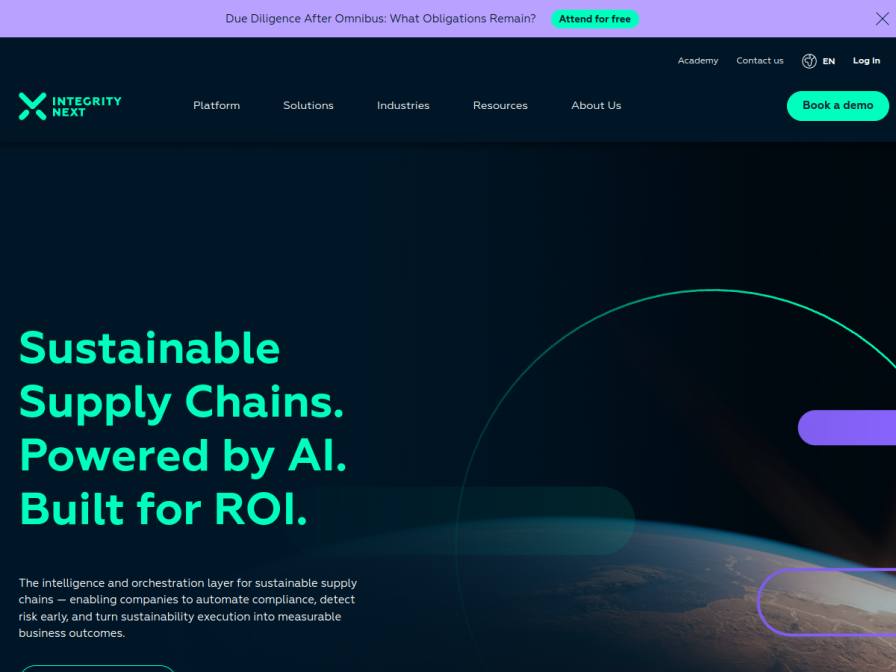
10 fictional AI personas. Exploratory perspectives, not a survey of real customers. Methodology & limitations
Simulated interest
AI synthesis, not measured demand
Suggested price range
No numeric price estimates in the answers. Ask a pricing follow-up to collect them.
Response sentiment
What this panel suggests
First-time visitors appear intrigued by IntegrityNext’s promise of AI-driven automation and the clear regulatory coverage across supply chain due diligence, product compliance, carbon, and reporting. The strongest positive reaction is to the headline-level value proposition: it feels relevant to heavy compliance and supplier-management workloads. However, the page leaves major buying questions unanswered. The most common friction is pricing transparency: respondents say they cannot find even a ballpark cost, and without that context they struggle to judge fit or justify further evaluation. A second concern is implementation reality: buyers want to know how the platform integrates with their existing systems and how it handles messy supplier data, not just the idealized workflow. There is also some skepticism that the ROI story applies equally well to smaller organizations, even though the page positions the product for companies of all sizes. What would most likely move them toward signup is concrete pricing guidance, clearer implementation and integration detail, and proof that the ROI and automation claims hold up for their company size and use case.
Pricing & positioning
Lead with a clearer pricing path and a low-friction evaluation flow: a transparent ballpark, implementation expectations, and a demo that shows how the platform handles real supplier-data workflows. First-time visitors seem interested enough to keep exploring, but many need practical proof before they will convert.
Do not treat the absence of willingness-to-pay data as rejection. The main issue is missing price context, not proven price resistance. A pricing page, package examples, or a 'starting at' anchor could reduce friction without forcing a hard sell.
Recurring themes
“The headline "Sustainable Supply Chains. Powered by AI. Built for ROI." is clear and directly addresses my pain points.”Read Sidney Hoffman’s response →
“What's unclear is the pricing structure – I can't find any indication of cost.”Read Sidney Hoffman’s response →
“How does the platform integrate with our existing systems, like our legal screening service?”Read Bessie Mayert’s response →
Objections to investigate
- Missing Pricing Information
- Unclear Integration with Existing Systems (Spreadsheets/Email)
- Skepticism Regarding ROI Applicability to Smaller Companies
Use these findings to plan customer interviews or experiments. How to interpret AI research
What the panel said
Click a name to open that persona’s full profile.
Sidney HoffmanneutralThe headline "Sustainable Supply Chains. Powered by AI. Built for ROI." is clear and directly addresses my pain points. The mention of automating compliance and detecting risk early is appealing, as my current Excel-based system feels very manual. I appreciate that the page highlights specific solutions like the German Supply Chain Act (LkSG), which is relevant to my role. What's unclear is the pricing structure – I can't find any indication of cost. Given my company's size and the demands on my time, seeing concrete pricing would help me assess if it's worth a demo, otherwise, I'll likely leave to investigate other options.
Jerry ChamplinneutralThe promise of "Sustainable Supply Chains. Powered by AI. Built for ROI." sounds very appealing, given my current workload. However, it's not entirely clear how it directly helps with a company of my size. I'm seeing a lot of broad solutions for "all industries and sizes," but I'd need to understand if it's truly scalable down to a 120-person operation and how it would integrate with our existing (mostly spreadsheet-based) systems. The mention of 180% ROI is impressive, but I'd need to see concrete examples or a clear breakdown of how that's achieved, especially for a smaller importer like us, before considering a sign-up. The lack of pricing information is also a barrier – how would I even begin to justify a cost without knowing the ballpark?
Simulated interest: 30/100
Bessie MayertneutralAs I land on the IntegrityNext website, the first thing that catches my eye is the claim of AI-powered automation for supply chain sustainability. As a compliance manager, I'm constantly juggling spreadsheets, certificates, and audit summaries. The promise of a platform to automate these tasks is intriguing, especially given the recent regulatory changes like the EU Deforestation Regulation (EUDR) and the Packaging and Packaging Waste Regulation (PPWR). The page highlights a 180% ROI over three years, which could be a game-changer if true. However, some things remain unclear: How does the platform integrate with our existing systems, like our legal screening service? Will it handle the nuances of our industry, specifically food packaging? And does it reduce manual effort while ensuring accuracy? My hesitation lies in transitioning from a manual process to a new tool, but a demo or case study might ease my concerns.
Simulated interest: 60/100
Baladitya NambeesanneutralThe headline, "Sustainable Supply Chains. Powered by AI. Built for ROI." certainly grabs my attention, especially the ROI part. However, it's not immediately clear how the platform specifically addresses the challenge of consolidating data from suppliers who still use PDFs via email, which is a significant pain point for me. The page mentions "automating compliance" and "measurable business outcomes," which sounds promising. To consider signing up, I'd need to see concrete examples or case studies demonstrating how it handles disparate data formats and the time-consuming manual consolidation I currently face. Understanding the integration capabilities with existing systems and the potential cost would also be crucial.
Simulated interest: 60/100
Mireille PhilippeneutralThe title "All-in-one Supply Chain Sustainability Management" is clear, and the mention of AI and ROI is appealing. However, the actual mechanics of how it achieves this are not immediately obvious. I would leave if I couldn't quickly understand the platform's core functionality and how it integrates with existing systems like EcoVadis. To sign up, I'd need to see more concrete examples of how it addresses data quality issues with smaller suppliers and evidence of its ability to automate reporting and compliance, which are my current pain points. A clear breakdown of features and pricing would be beneficial.
Simulated interest: 60/100
Manuel MeyerneutralThe headline "Sustainable Supply Chains. Powered by AI. Built for ROI." immediately grabs my attention, as does the claim of 180% ROI. However, it's unclear how they achieve that for a company like mine, an 180-person industrial distributor. I'd leave if I couldn't quickly understand the cost and whether it scales down to my company's size, or if the implementation seemed too complex given my limited team. What would make me sign up is clear, transparent pricing and a demonstration of how this platform solves my specific problems like manual data collection and limited buyer bandwidth, ideally with a case study from a similar-sized company.
Simulated interest: 60/100
Asia PillitteripositiveThe landing page emphasizes how IntegrityNext automates compliance, detects risks early, and turns sustainability into measurable outcomes. As a Vendor Compliance Specialist, I'm drowning in manual processes—spreadsheets and shared drives—that slow me down. The promise of 80% faster supplier onboarding and 70% less time assessing risk is compelling, especially during our annual audit season. However, I'm unclear: (1) Does this integrate with our existing tools, or will we need a full overhaul? (2) What’s the learning curve for my team? The ROI claim is impressive (180%), but I wonder how accurate that is for a mid-sized firm like ours. The “Book a Demo” button is enticing, but I’d need buy-in from leadership first. If this truly reduces time chases and compliance gaps, I’d push for a trial.
Simulated interest: 75/100
Spirydion BielskineutralThe page immediately presents a lot of information regarding supply chain sustainability, which is relevant to my work. However, the sheer volume of listed regulations like EUDR, LkSG, and CSRD could be overwhelming. While it claims "All-in-one," it's unclear how it specifically helps with the manual document tracking and data entry I currently do in Excel. What makes me hesitate is the lack of detail on the integration process and how it handles the messy reality of supplier documentation. To sign up, I would need a clearer demonstration of how it simplifies my daily tasks, perhaps a trial or a more targeted explanation of its AI capabilities for data analysis and risk flagging, especially for smaller furniture exporters like mine.
Simulated interest: 50/100
Carlota Sandoval SisnerosneutralThe headline "Sustainable Supply Chains. Powered by AI. Built for ROI." is clear and directly addresses my needs. I appreciate the emphasis on ROI, as that resonates with our company's focus. However, the specifics of how the AI layer operates and the exact functionalities for managing PDF certificates and supplier questionnaires aren't immediately apparent. I would need to see more detail on the platform's user interface and how it handles the manual processes I currently manage with spreadsheets. If it demonstrably simplifies document collection and status tracking, and provides clear reporting for finance, I would definitely consider signing up. The mention of a "Book a demo" button is a good next step.
Simulated interest: 70/100
Clinton HillsneutralThe headline "Sustainable Supply Chains. Powered by AI. Built for ROI." is a good start, and the mention of "80% faster supplier onboarding" and "70% less time spent assessing risk" definitely catches my eye, given how much time I currently spend on those tasks manually. However, I'm not sure how they achieve that or what the actual platform looks like. It seems like a lot of focus on regulations like LkSG and CSDDD, which are important, but I'd need to see how it directly translates to simplifying my current spreadsheet chaos. I'd be more inclined to sign up if I could see a clear, step-by-step process for how it would address my specific pain points, maybe with a more concrete example of how it handles data consolidation from diverse suppliers. Without seeing the actual interface or a more tailored demonstration of its capabilities for a company our size, it's hard to fully commit.
Simulated interest: 60/100
Keep exploring.
Find your next question or see which topics divide AI panels.
What would you ask next?
Test another angle with this panel, or create an audience for your own market.