
You land on https://www.esopvalueclarity.com/ (ESOP Value Clarity) for the first time. What's unclear, what makes you leave, and what would make you sign up?
Page reviewed
ESOP Value Clarity: ESOP Calculator and Cap Table Tool for India
https://www.esopvalueclarity.com/ (opens in a new tab)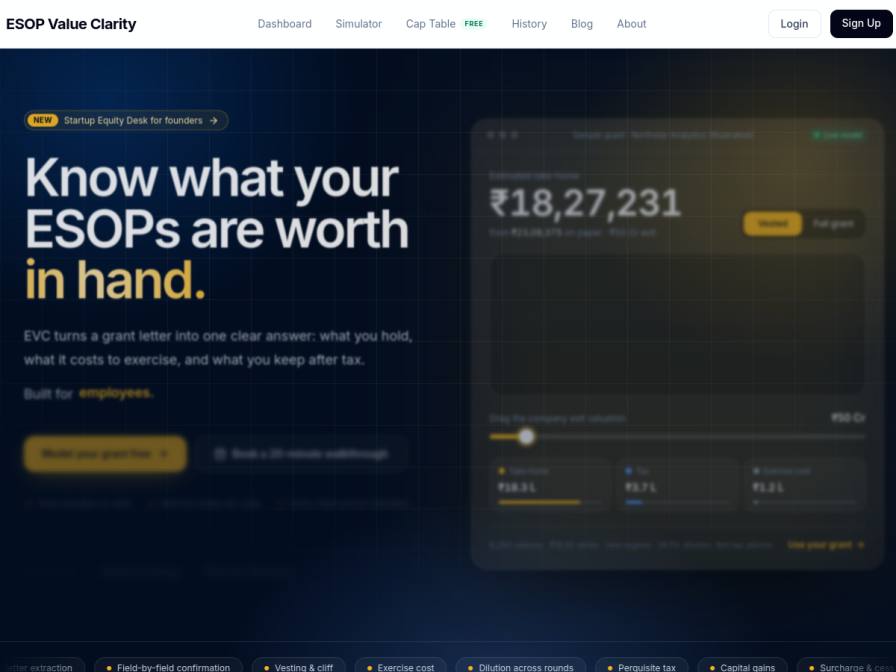
10 fictional AI personas. Exploratory perspectives, not a survey of real customers. Methodology & limitations
Simulated interest
AI synthesis, not measured demand
Suggested price range
No numeric price estimates in the answers. Ask a pricing follow-up to collect them.
Response sentiment
What this panel suggests
The page’s core promise lands: turning an ESOP grant letter into a clear rupee answer, including exercise cost, dilution, and after-tax take-home, is the part people find most useful. The biggest drop-off trigger is relevance. The product is explicitly built for Indian tax rules, which is a strength for the intended audience, but several respondents read that as a hard mismatch and assumed the tool was not for their market. That is a perception issue, not a product defect. A second source of friction is uncertainty about what is free versus paid: people want to know what the simulator covers, what PRO adds, and why they should sign up rather than just try the free flow. Trust also matters. The page says calculations are source-checked and India-specific, but respondents still want confidence that the tax engine handles real-world edge cases before they commit. Finally, some friction comes from the implied workflow of uploading and confirming grant details; anything that feels like too much manual work makes sign-up less likely. The strongest signup trigger is clearer proof that the output is accurate, useful, and fast to obtain for the user’s specific jurisdiction and role.
Pricing & positioning
Position monetization around the Indian use case first, then test whether clearer jurisdiction messaging and stronger trust signals convert the neutral audience. Do not infer pricing resistance from this batch; willingness-to-pay was not actually established.
Make the free-vs-paid boundary explicit on first view: what the free simulator includes, what PRO adds, and who each plan is for.Reduce perceived risk with examples of source-checked outputs, tax handling, and what is not modelled.If expansion beyond India is planned later, signal that separately instead of letting international visitors assume the product is irrelevant.
Recurring themes
“The core proposition of ESOP Value Clarity – breaking down ESOP grants into clear, actionable numbers – immediately grabs my attention.”Read Prasad Trivedi’s response →
Objections to investigate
- Market mismatch for non-Indian users
- Unclear tier differentiation
- Manual data entry friction
- Need confidence in tax engine and local nuances
Use these findings to plan customer interviews or experiments. How to interpret AI research
What the panel said
Click a name to open that persona’s full profile.
Vaishno GandhineutralThe core offering – translating grant letters into clear financial outcomes in rupees, considering Indian tax – is very appealing. It directly addresses a problem I face weekly: explaining complex ESOP terms to our team. However, the jump from the free simulator to the "Startup Equity Desk for founders" needs more clarity on what specific features are included for our team size and my role as COO. I'd need to understand how it integrates with my current Google Sheets modeling and if it truly simplifies my process of modeling dilution and future scenarios before board updates. Signing up would depend on seeing a clear path for team-wide adoption and seamless integration into my workflow.
Simulated interest: 60/100
Johnnie DonnellynegativeMy immediate thought is that this is for India. My startup is in San Francisco, so the "Built for Indian tax rules" is a non-starter. It looks like a useful tool for employees to understand their grants, and the "Startup Equity Desk" for founders might be interesting if it were US-focused. The cap table builder and the ability to run ESOP grants are features I manage in Carta, so I'm always looking for ways to improve that process, but the geographic limitation here is a dealbreaker. I'd leave because it's clearly not designed for my market.
Simulated interest: 0/100
Loretta VandervortneutralAs someone who's knee-deep in EMI administration and constantly juggling spreadsheets, Capdesk, and payroll integrations, the premise of ESOP Value Clarity is compelling. Knowing exactly what employee ESOPs are worth in hand—accounting for vesting, exercise costs, and taxes—could save hours of back-and-forth with employees and advisors. The four-step workflow (upload, confirm, model, share) aligns well with my current pain points of manual spreadsheet work and ad-hoc equity education sessions. The transparent reporting and traceability to the grant letter itself also appeal to my compliance-driven mindset. However, I’d want to see a demo with our actual EMI grant letters to ensure it aligns with our specific tax and regulatory nuances. The 'Startup Equity Desk' might also help streamline our cap table updates, but integrating it with our existing tools (like payroll and Capdesk) would be critical. The lack of liquidation preferences and buyback-specific tax treatment in exit scenarios is a notable gap for our needs. The pricing ($14,999 annually for up to 25 employees) seems steep for our current budget, especially since we’re already investing in Capdesk. That said, if it meaningfully reduces our administrative burden, it could justify the cost.
Simulated interest: 60/100
Kaan SchwennennegativeThe biggest initial confusion is the focus on India. My company is in Berlin, and I'm dealing with German tax law, not Indian. The site mentions "Indian tax rules built in" and "Rupees, lakhs and crores," which immediately makes me question its applicability. While the idea of automatically processing grant letters and modeling scenarios is appealing, the geographical limitation is a significant hurdle. I'd leave because it seems designed for a different market. To make me sign up, you'd need to clearly state if there's a European or specifically German version, or how you account for different tax jurisdictions. Otherwise, the tool is irrelevant to my needs.
Simulated interest: 10/100
Prasad TrivedipositiveThe core proposition of ESOP Value Clarity – breaking down ESOP grants into clear, actionable numbers – immediately grabs my attention. It directly addresses my problem of meticulously tracking these details for my own offers. What feels unclear initially is the exact methodology for how the 'grant letter extraction' works and the true depth of the Indian tax rules it claims to incorporate, especially concerning surcharges and cess. I'd leave if I felt the "source" of the data wasn't robust or if the tax calculations seemed too generic. I would sign up for the free simulator to test its accuracy with my current offers, especially to compare scenarios and see the final take-home value after taxes and exercise costs, which is my primary concern. If it proves reliable and saves me the hours I currently spend on my spreadsheet, the PRO subscription for ₹2,999 per month might be justifiable for the time savings and clarity it offers.
Simulated interest: 75/100
Angelina van LeeuwennegativeThe biggest thing that's unclear is the mention of "India" throughout the page. My startup is in Amsterdam, so I immediately question if this tool is relevant to me. It seems to focus heavily on Indian tax rules and currency, which isn't directly applicable to my situation. While the concept of calculating ESOP value and dilution is highly relevant, the specific implementation here seems geographically limited. I would leave because of the Indian focus, but if it could be adapted to Dutch regulations and currency, or if there were a clear indication of international applicability, I might consider signing up for a demo to see if the underlying functionality is robust enough to be adapted.
Charles AltenwerthneutralI land on the ESOP Value Clarity website, and the first thing I notice is the focus on transparency—knowing exactly what my ESOPs are worth after taxes and exercise costs is appealing. However, the site makes a few assumptions that don’t align with my manual, handcrafted approach. For one, it promises speed and automation, but I’ve built trust in my spreadsheet’s accuracy by handling everything personally. The live model on the page seems slick, but I’d need to see how it compares to my 27-tab Excel monolith. Their mention of ‘built for Indian tax rules’ is promising, but I’d want to verify how their calculations handle the nuances I’ve sweated over. The Startup Equity Desk seems designed for a different stage—we’re still growing, and I’m cautious about delegating this to a tool. I’d leave this page for now, but I’d bookmark it for later. If I’m going to let a tool handle my equity grants, it’ll need to prove it can replicate my level of scrutiny.
Simulated interest: 30/100
Bala ButtneutralInitially, the site is quite clear on its purpose: calculating the 'take-home' value of ESOPs. However, I'm unsure about the distinction between the free simulator and the PRO features. It would be helpful to see more about what's included in the free tier. What makes me hesitate is the reliance on manual uploads for grant letters; I’d prefer a more integrated system if this were for company-wide use. To sign up, I'd need to understand how this integrates with our existing spreadsheets, especially concerning compliance and data security, and see a clearer breakdown of the PRO features versus the free simulator.
Simulated interest: 40/100
Fernando SteuberneutralThe core value proposition, clarifying ESOPs in rupees after tax, is immediately clear. However, the explicit mention of "India" in the title and description raises a flag – as I'm in Dublin, the tax implications might not be directly applicable. What's unclear is the extent to which it can adapt to non-Indian tax regimes. While the "Startup Equity Desk for founders" sounds interesting for our internal use, I'd need to understand its integration with Capdesk. I'd leave if it's strictly limited to Indian tax law. To sign up, I'd need to see if it supports Irish tax scenarios, or at least provides a robust framework that can be adapted, and potentially a clearer path to integrating it with our existing systems.
Simulated interest: 30/100
Émérance MartynegativeThe biggest immediate red flag is the explicit mention of "India" in the title and description. My company and my employees are in France, and French labor and tax laws are complex. I would leave immediately because this tool likely isn't relevant to my needs. If, however, it *did* support French regulations, I'd be interested in seeing how it handles the manual synchronization issues I face with our local payroll advisor. Signing up would depend entirely on whether it could accurately reflect French tax law and integrate seamlessly with our existing systems, which seems highly unlikely given its current focus.
Simulated interest: 10/100
Keep exploring.
Find your next question or see which topics divide AI panels.
What would you ask next?
Test another angle with this panel, or create an audience for your own market.