
You land on https://chessflow.fr/ (ChessFlow) for the first time. What's unclear, what makes you leave, and what would make you sign up?
Page reviewed
ChessFlux — entraîneur de répertoires d'échecs
https://chessflow.fr/ (opens in a new tab)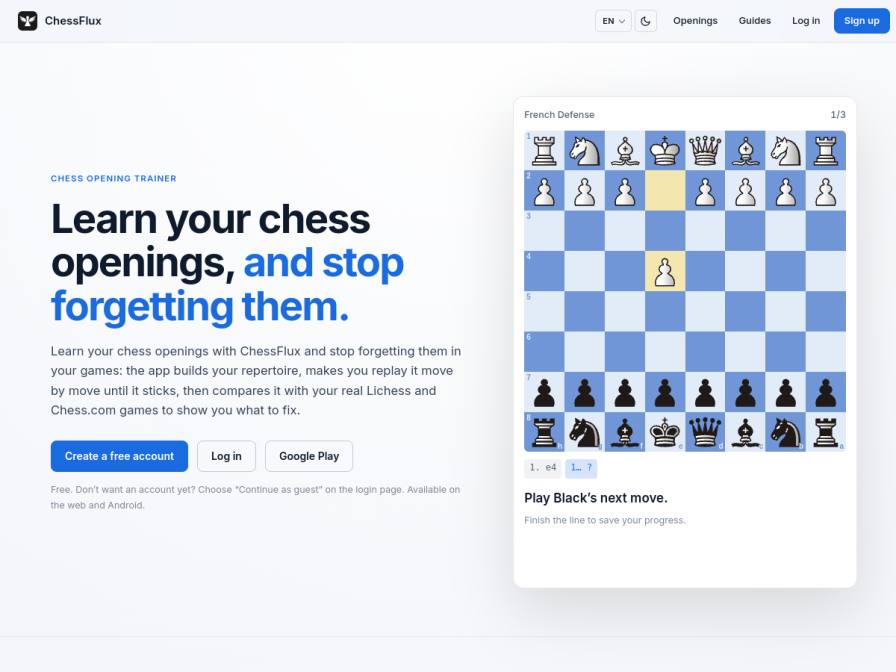
10 fictional AI personas. Exploratory perspectives, not a survey of real customers. Methodology & limitations
Simulated interest
AI synthesis, not measured demand
Suggested price range
No numeric price estimates in the answers. Ask a pricing follow-up to collect them.
Response sentiment
What this panel suggests
First-time visitors generally understand the core promise quickly: ChessFlux is an opening trainer that can build a repertoire from your own Lichess, Chess.com, or PGN data, then drill it until it sticks. That value proposition is the strongest driver of interest, especially for players who want something more practical than a generic opening database. The biggest friction is not the chess concept itself, but clarity. Several responses show confusion about the rebrand from ChessFlow to ChessFlux, even though the page says it is the same app and that old links still work. That suggests the naming change is creating trust and continuity questions at first glance. A second recurring uncertainty is what is actually included for free versus what sits behind Premium. The page says free accounts can create repertoires, train, and solve puzzles, but respondents still wanted a sharper breakdown of limits and paid features. People seem most likely to sign up if the site immediately confirms the rebrand, shows a simple free-vs-paid comparison, and makes the import-to-training flow feel concrete and low-risk, ideally with guest access or a quick demo of the repertoire builder.
Recurring themes
“The ability to import my Lichess/Chess.com games to build a repertoire is particularly appealing”Read Armando Jones’s response →
“the main thing that's a bit unclear is the name change – "ChessFlow is now ChessFlux?"”Read Anish Naik’s response →
“What's unclear is the extent of the free tier's limitations, especially regarding the "training targeted" aspect mentioned for Premium”Read Armando Jones’s response →
Objections to investigate
- Unclear free tier limitations
- Rebranding confusion (ChessFlow vs. ChessFlux)
- Lack of specific feature breakdown
Use these findings to plan customer interviews or experiments. How to interpret AI research
What the panel said
Click a name to open that persona’s full profile.
Armando JonesneutralLanding on ChessFlow, now ChessFlux, the core value proposition of building and retaining an opening repertoire is clear. The ability to import my Lichess/Chess.com games to build a repertoire is particularly appealing, as it directly addresses my problem of needing to analyse my own play. The fact that it compares my games against my repertoire and suggests corrections is exactly the data-driven approach I appreciate. What's unclear is the extent of the free tier's limitations, especially regarding the "training targeted" aspect mentioned for Premium. I'd leave if the free version felt too restrictive or if the interface seemed cluttered and inefficient for quick study sessions during my commute. I'd sign up because the integration with my existing accounts and the focus on practical application align well with my structured learning style and goals, provided the free tier offers enough functionality to get started.
Simulated interest: 75/100
Antoinette ArmstrongneutralI landed on ChessFlux because I'm always looking for ways to better organize my students' opening notes. The idea of it building a repertoire from their actual games or importing PGNs is intriguing, especially since I spend so much time manually preparing those handouts. What's unclear is how much of this is truly automated versus how much input I'd still need to provide. I also don't see any mention of specific features for analyzing student games to find opening weaknesses. If it could genuinely streamline the creation of personalized opening materials and integrate smoothly with my current PGN files without costing much, I might consider signing up. The fact that there's a free option and a guest mode is a good start, given my budget concerns.
Simulated interest: 60/100
Anish NaikneutralOkay, so I land on ChessFlux, and the main thing that's a bit unclear is the name change – "ChessFlow is now ChessFlux?" – I'd need to know if my old data, like studies, would transfer. It sounds promising though, especially building a repertoire from my own Lichess/Chess.com games and getting analysis on where I go wrong. The "continue as guest" option is great because I hate making accounts initially. What would make me sign up is knowing the "Premium" features aren't essential for core functionality, since I rely on free tools like Lichess studies. If the free tier offers enough to rebuild my lines and get feedback, I'm definitely in. Otherwise, I'd probably stick to my current method of manually analyzing databases and YouTube clips.
Simulated interest: 60/100
Albert SutschetneutralLanding on ChessFlux, the immediate impression is that it's a dedicated tool for chess opening preparation, which aligns with my own rigorous training methods using ChessBase. The core functionality of building repertoires from my own games on Lichess or Chess.com is particularly appealing. However, the transition from ChessFlow to ChessFlux is noted, and while reassuring that data is preserved, it's a detail that could be clearer upfront. What's not entirely clear is the depth of integration with external analysis tools or the specific types of engine annotations it supports beyond just comparing lines. To sign up, seeing a clear breakdown of premium features versus the free offering would be beneficial, and perhaps a trial period for premium would solidify my decision.
Simulated interest: 75/100
Artémis VasseurneutralThe name change from ChessFlow to ChessFlux is a bit confusing, but the core idea of building and reinforcing opening repertoires is highly relevant to my work. The ability to import PGNs and analyze my students' Lichess/Chess.com games directly to identify weaknesses is particularly appealing. I appreciate that it can help consolidate my Notion/PGN preparation. What's unclear is the depth of customization for my own opening packets and how it integrates with my current Notion workflow. The premium features are not detailed, which is important given my budget constraints. However, the potential to streamline my preparation and provide better data to students makes me want to explore it further, especially the free tier.
Simulated interest: 70/100
Timothy NaderpositiveThe name change from ChessFlow to ChessFlux is a bit unclear, but the core functionality described, especially the ability to build a repertoire from my own Lichess and Chess.com games and then train it, is exactly what I need. The idea of analyzing my actual games to identify corrections and weaknesses is highly appealing. I would sign up if the integration with my existing platforms is seamless and the training tools are as described. The potential to refine my opening play without manual line building is a significant draw, given my current spreadsheet and binder system.
Simulated interest: 85/100
Loïs VermeulenneutralAs a teacher, I'm always looking for ways to help my chess pupils. The idea of building their repertoire from their own Lichess or Chess.com games is really appealing, as is the "debrief" feature to see where they stray. What's unclear is how the "active repetition" actually works in practice for kids this age, and if there's a way to integrate it with the shared documents I already use. I'd also want to know if there's a limit to the number of games or openings I can analyze for free. If I could easily import and organize lines for my six pupils, and the platform felt intuitive and visually engaging for them, I would definitely sign up for a free account to try it out for my team.
Simulated interest: 70/100
Julius SauerneutralRight, first off, this ChessFlow thing, which is now ChessFlux, is a bit confusing with the name change. It says it can build a repertoire from my Lichess or Chess.com games, which sounds handy, but I'm not sure how much it'll cost to use properly. I prefer keeping things low-cost, using my notebook mostly, so I'd need to see if the free version is actually useful. I'd consider signing up if the free account lets me do the main stuff, like importing my games and training, without needing a subscription. If it's all behind a paywall, I'll stick to my paper and pencil.
Simulated interest: 40/100
Ernesto Arreola TejadaneutralAt first glance, ChessFlux seems promising because it addresses a major frustration of mine: efficiently managing and remembering opening repertoires. I’m constantly juggling Chessable, Notion, and engine checks, which is time-consuming and error-prone. ChessFlux’s ability to import my Lichess and Chess.com games to build a repertoire appeals to me because it integrates my existing online gameplay seamlessly. The emphasis on active practice through puzzles and move-by-move replay is something I find valuable, as I often forget key lines under game pressure. However, a few things are unclear: How well does the app handle annotations and variations? Does it offer detailed statistics on my opening performance? The free tier is attractive, but I’d need assurances that the premium features are worth upgrading to. If it can simplify my preparation and reduce blunders in club matches, I’d be inclined to give it a try.
Simulated interest: 70/100
Daksha MehraneutralThe concept of ChessFlow, or ChessFlux as it's now called, is intriguing. The idea of automatically building a repertoire from my students' Lichess or Chess.com games is exactly what I need. It would save me hours of manual data entry after every tournament. What's unclear is how it handles variations and if it can integrate with our current system of tracking in WhatsApp or Google Sheets – though I suspect it aims to replace that. I'd leave if it wasn't straightforward to set up for multiple students. What would make me sign up is a clear, quick way to input my 20 students' profiles and see immediate value in organizing their opening prep. Seeing it work seamlessly for a few students would be a strong convincer.
Simulated interest: 85/100
Keep exploring.
Find your next question or see which topics divide AI panels.
What would you ask next?
Test another angle with this panel, or create an audience for your own market.