
What do you use today instead of AI Photo Tag (https://describepicture.org/photo-tag/) (a competitor, a spreadsheet, doing it by hand)? Compared with that, what would make AI Photo Tag better or worse for you, and what would keep you on your current option? Also say the maximum you would pay per month in USD (0 if nothing).
Page reviewed
AI Photo Tag | Smart Image Description & Tags
https://describepicture.org/photo-tag/ (opens in a new tab)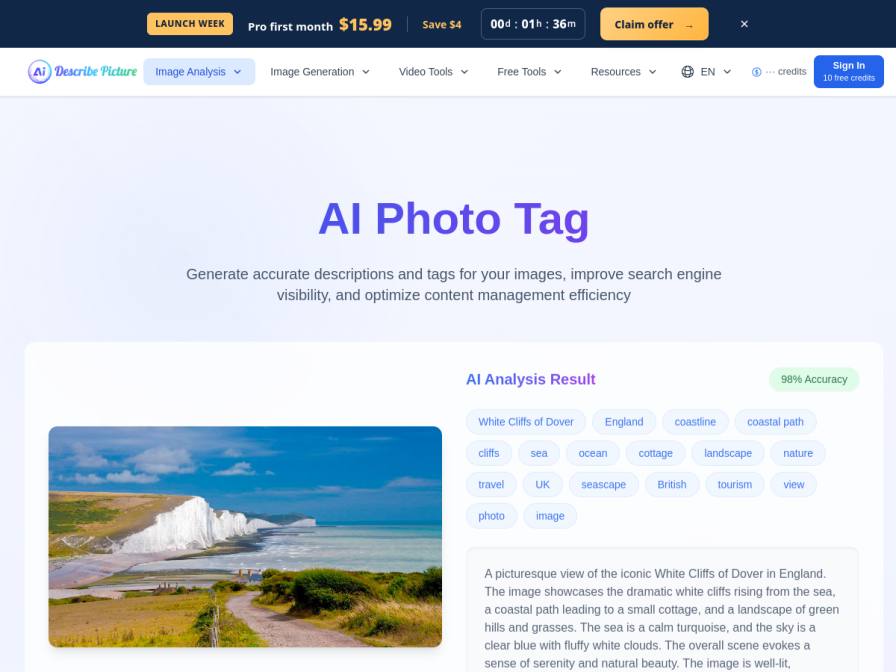
10 fictional AI personas. Exploratory perspectives, not a survey of real customers. Methodology & limitations
Simulated interest
AI synthesis, not measured demand
Suggested price range
Median $10 · simulated willingness to pay
Response sentiment
What this panel suggests
Respondents mostly described today’s substitute as manual tagging, spreadsheet-based workflows, or whatever they already use to organize image files. The main reason to switch is time savings: AI Photo Tag looks attractive when it can remove repetitive work, especially for batch processing and large libraries. What would make it better is clear workflow compatibility, especially with existing systems such as Google Drive, Lightroom, or Adobe Bridge, plus the ability to enforce custom vocabularies and keep tags consistent with an established schema. What would make it worse is generic or inaccurate tagging that creates cleanup work, or any uncertainty about the recurring subscription price. The page claims batch processing, custom tag rules, and EXIF/IPTC export, but respondents still want proof that those capabilities fit their specific workflow rather than just being available in principle. Aggregate willingness to pay in this sample is modest but real: $0 at the low end, $10 median, and $20 high per month. Overall, this looks like a utility purchase for people with repetitive tagging pain, not a must-have for everyone.
Pricing & positioning
Keep monetization simple and explicit: a low-friction monthly plan with a free trial or free credits, plus a clearly stated recurring price. The sample suggests interest is strongest when the tool saves manual tagging time and works in batch, but buyers may stay with current workflows if integration, control, or price remain unclear.
The supplied WTP data centers around a $10/month median, with a low of $0 and a high of $20. That supports testing a starter tier near $9.99 and a higher tier near $19.99, while making the post-launch monthly price unmistakable.
Recurring themes
“AI Photo Tag seems like it could save me a lot of time by automating the tagging process”Read Eileen Cronin’s response →
“I'm concerned about how well it would integrate with our current workflow”Read Eileen Cronin’s response →
“My primary concern would be data integrity and consistency with our established schema”Read Willie Stanton’s response →
“I'd need to understand the ongoing subscription costs beyond that initial period”Read Ramon Kuhn’s response →
Objections to investigate
- Unclear long-term pricing after launch offer
- Fear of inaccurate or non-specific tags requiring manual correction
- Lack of integration with existing tools (Google Drive, Lightroom, Adobe Bridge)
- Inability to customize tags for controlled vocabularies or industry-specific terms
Use these findings to plan customer interviews or experiments. How to interpret AI research
What the panel said
Click a name to open that persona’s full profile.
Eileen CroninneutralRight now, I use a combination of shared folders, spreadsheet tags, and batch renaming, which is pretty manual. The biggest problem is inconsistent naming conventions from our photographers, so I spend a lot of time cleaning things up. AI Photo Tag seems like it could save me a lot of time by automating the tagging process, which is a definite plus. However, I'm concerned about how well it would integrate with our current workflow and if the tags would be specific enough for our home goods products. I'd need to see if it can handle custom contexts or if I can fine-tune the tags it generates. If it can significantly reduce my manual cleanup time and improve consistency, that would be valuable. I'd be willing to pay around $15.99 per month to try it out, especially with the launch offer.
Simulated interest: 75/100
Ramon KuhnneutralCurrently, I use Adobe Bridge and a fairly meticulous manual process, often involving spreadsheets, to keyword and tag my images. I'm always looking for ways to streamline that, especially during peak wedding season when I'm dealing with hundreds of shots. AI Photo Tag's promise of automatic tagging and metadata export is appealing, as it could save significant time. The 98% accuracy claim is impressive, but I'd need to test it thoroughly to see how it handles the specific nuances of wedding details or product textures. My current method, while time-consuming, gives me absolute control and ensures I'm not missing anything crucial. The biggest hurdle would be if the AI's tags aren't specific enough or if it introduces irrelevant keywords that I'd then have to correct. The price of $15.99 for the first month seems reasonable for a trial, but I'd need to understand the ongoing subscription costs beyond that initial period to gauge its long-term value. I'm willing to pay up to $10 per month for a tool that demonstrably saves me time without compromising quality.
Simulated interest: 60/100
Franka HallmannneutralCurrently, I manage our campaign images, UGC, and influencer assets manually in Google Drive and a shared spreadsheet. I'm always looking for ways to streamline our workflow, especially with a small team and a limited budget. Automating the tagging process with AI Photo Tag sounds promising, as it could save a lot of time. The batch processing feature is particularly appealing for handling multiple image sets. What I'm unclear about is the exact pricing structure beyond the initial "Pro first month $15.99"; is that a recurring monthly fee for continued use? If so, I would be willing to pay up to $10 per month, provided it significantly speeds up my asset management and requires minimal learning curve.
Simulated interest: 70/100
Chaturaanan KaniyarpositiveCurrently, we sort and manually tag hundreds of ceremony and portrait images for each wedding. This process is very time-consuming, essentially taking up a significant portion of my day. Your AI Photo Tag could be a significant improvement by automating the tagging, which would save us hours of manual effort. The accuracy rate of 98% sounds promising. However, I'd need to understand if it integrates with Google Drive or our existing file management system. The primary concern would be the reliability and consistency of the tags for our specific needs. If it truly streamlines the process without introducing new complications, it would be valuable. I would consider paying up to $20 per month.
Simulated interest: 75/100
Willie StantonneutralCurrently, I do all of my cataloging manually. I apply subject, place, and date fields using controlled vocabularies, and I meticulously check original file names. AI Photo Tag's ability to automatically generate tags and descriptions could save significant time, which is always a concern given the volume of material. However, I'd need to understand how well its tags align with controlled terminology and if it preserves original file naming conventions. The accuracy claim of 98% is impressive, but I'd want to verify that it's truly accurate for historical local images. My primary concern would be data integrity and consistency with our established schema. If it can genuinely speed up the process without compromising accuracy or requiring extensive manual correction, it might be worth considering. I'm hesitant to pay for something that might not fit our specific needs or that could introduce errors we'd then have to fix. For now, I would pay $0 per month.
Simulated interest: 20/100
Javier KlingneutralRight now, I'm manually renaming hundreds of property photos every week, which is incredibly time-consuming. I've also tried using spreadsheets to keep track of room labels, but it's not ideal for managing image metadata directly. AI Photo Tag's ability to automate tag generation and embed them into the image files seems like a significant efficiency gain. The batch processing feature is also appealing. However, I'd need to see how well it handles specific real estate terminology and if it can be customized to fit our brokerage's strict naming conventions. The "Pro first month $15.99" offer is intriguing, but I'd need to understand the ongoing monthly cost after that. I'm willing to pay up to $20 per month if it proves to be a reliable time-saver.
Simulated interest: 75/100
Vrinda PandeyneutralRight now, I use my phone's camera and Google Drive to keep track of my product photos, and I use Google Sheets for details like SKU, size, and color. It works, you see, but sometimes it's hard to find specific images quickly. This AI Photo Tag tool could be better because it seems to automatically tag everything, which would save me so much time compared to how I do it now, by hand. But I'm cautious about paying for new software. My current system is free, and I'm used to it. Also, I'm not sure how well it handles slight color differences, which is a problem I have. If it's very accurate and fast, I might consider paying. Maybe around $5 per month for a start?
Simulated interest: 40/100
Mas JacobsneutralCurrently, I rely on meticulously organizing images in Lightroom and manually updating a shared spreadsheet with all the necessary metadata, usage rights, and captions. The main advantage of AI Photo Tag for me would be automating the tedious tagging process, saving considerable time. However, I'm concerned about how well it integrates with my existing workflow and whether the AI's accuracy truly matches the detail I need for rights management. The biggest hurdle would be the cost, as our startup has a tight budget. I might consider paying up to $10 per month if it proves significantly more efficient and reliable than my current system.
Simulated interest: 50/100
Gina WittingneutralCurrently, I rely on a combination of manual tagging within Google Photos and organizing my scanned photos into specific year and event folders on my hard drives. This approach, while time-consuming, is familiar and doesn't require additional expense. The AI Photo Tag tool sounds interesting, particularly its claim of 98% accuracy and batch processing, which could potentially save a significant amount of time. However, I would need to be assured of its long-term reliability and how well it integrates with my existing systems. I am hesitant to pay for something that might not be a substantial improvement over my current methods or might introduce new complexities. If it proves to be consistently accurate and seamless, I might consider a price of around $5 per month, but that would be my absolute maximum.
Simulated interest: 30/100
Ines de JongeneutralCurrently, my team and I rely on Adobe Bridge and network folders for keywording and organizing our assets. We manually tag and rename everything to ensure it's searchable. While this AI Photo Tag sounds like it could save time, I'm concerned about the accuracy and consistency of AI-generated tags compared to our deliberate process. Batch processing is appealing, but I'd need to see how it integrates with our existing system and preserves metadata across different file types. The "Pro first month $15.99" offer is interesting, but without a clearer understanding of how it scales for a small agency and its long-term value, I wouldn't be willing to pay more than $10 per month.
Simulated interest: 40/100
Keep exploring.
Find your next question or see which topics divide AI panels.
What would you ask next?
Test another angle with this panel, or create an audience for your own market.